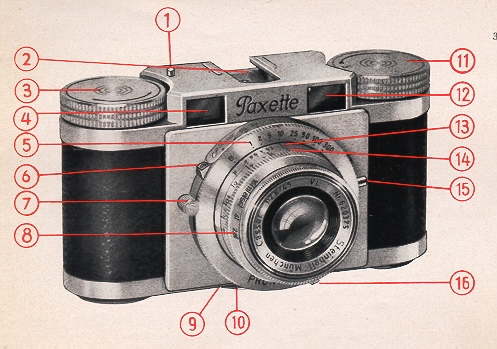
Key to numbers on opposite page.
1. Film locking stud
2. Film Counter
3. Knob for winding
on film and winding shutter
4. Optical exposure meter
5. Shutter setting
6. Socket
for cable release
7. Shutter release lever
8. Lens
aperture control
9. Locking ring
10. Tripod hush (1/4' Whitworth)
11. Film rewinding
knob
12. Optical eye level view finder
13. Depth of field
ring
14. Focusing ring
15.
Flash socket
16.
Delayed action release |
 |
The Paxette camera is made by
Carl Braun K. G. of Nuremberg under the most modern conditions.
The beautiful finish of the Paxette is
the first evidence of the quality of the plant and the skill and care of the
operatives which lie behind its production. Actual use of the camera very quickly
confirms the first impression. It will be found delightful to handle, thoroughly
reliable and an instrument capable of producing the most perfect pictures.
Careful study of this booklet is necessary to get the
best out of this camera. Once the mechanical details are mastered every photographic
problem can be faced with confidence and the Paxette
will become a constant friend and companion of leisure hours.
How to Open the Camera
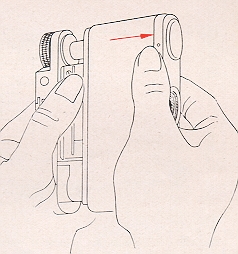 |
The milled locking ring on the bottom
of the camera is released by turning anti-clockwise. The back and bottom
of the camera can then be slid out. |
How to insert the film
cassette
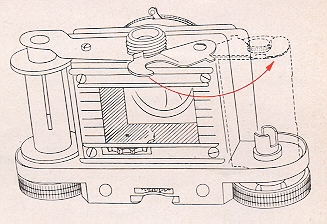 |
The arm which retains the cassette
is swung outwards by about 90° and the cassette is engaged in the REWIND
dog. The lever holding the cassette is then swung back again so that
it fits over the protruding spool knob.
|
Attention!
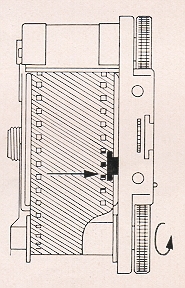 |
When film is inserted, it is imperative
that the margin of the film is sliding underneath the guide spring at
the right side of the cog-wheel. |
How to insert the film
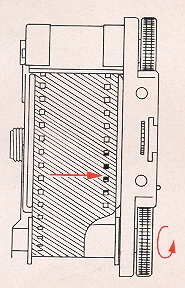 |
Pull out the film from the cassette
sufficiently far for the trimmed end to be inserted into the slot of
the empty spool and then bent back on itself so that it cannot slip.
Turn the film winding knob in the direction of the arrow until the sprocket
of the film transport engages with the perforations of the film. As
the turning of the film winding knob causes the shutter to be wound,
the shutter release ]ever should be operated every so often whilst winding
is in progress. This will enable the film to be wound on. Once the perforations
have engaged the sprocket, the back of the camera should be replaced
and locked. |
Warning: Direct sunlight should be avoided when loading with film.
If there is no shade, the operator's own shadow in better than direct sunlight.
How to close the camera.
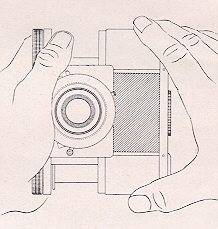 |
To close the camera the back should
be inserted between the camera housing and front plate and the locking
ring tightened. |
The film Counter
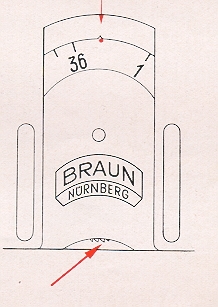 |
The film counter reads backwards
from 36 to 1. It thus indicates the number of unexposed frames still
available. After the film has been loaded and the camera has been closed,
the counter should be set at the red dot near the figure 36, by means
of the projecting teeth. The film winding knob is then turned until
the reading is 36. It is necessary to release the shutter to allow the
film to wind on. |
Film Winding and Film Transport
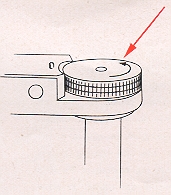 |
The shutter winding mechanism, film
transport and film counter are coupled so that they are operated when
the winding knob is wound in the direction of the arrow. After the shutter
has been released and until the camera has been re-wound, the safety
device which prevents double exposure is in operation. |
How to unload the Camera
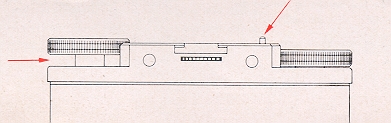 |
The whole length
of the film has been exposed when the counter reads figure 1 and the
shutter has been released.
To wind back
the film, press the locking stud; pull out the rewind knob as far as
it will go and turn it in the direction of the arrow. Towards the end
of the film a somewhat stronger resistance is felt which indicates that
the film is being held by the take up spool. |
A few further turns will then wind the film completely
into the cassette, and the camera can be opened for insertion of a new film.
Note: The locking stud must remain depressed throughout the
whole rewinding operation. It throws the sprocket out of gear.
Loading and Unloading Drill
1. Open the camera
2. Insert film cassette
3. Attach the
film to the take-up spool
4. Close the camera
5. Set the film counter on the red dot near 36
6. Wind on until 36 is against the
index mark |
1. Press down locking
stud throughout the winding operation
2. Raise rewind knob as far as it will go
3.
Turn rewind knob in the direction of the arrow
4. Wind the whole of the film into the cassette
5. Open the camera
6. Remove
the cassette |
Checking the film transport
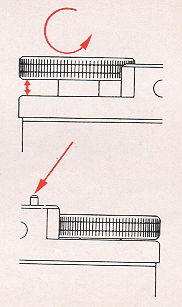 |
To make sure that
the film transport is functioning properly and the film really being
wound on, lift the rewind knob as far as it will go. If the film transport
is functioning properly the rewind knob will turn in the opposite direction
during winding operations.
Checking the Re-winding
To check the rewinding, release the locking stud during
rewind operations. It will then stand proud and there should be a strong
resistance if the mechanism is working correctly.
Warning. If force is used against this resistance
the perforation of the film will tear. When continuing to rewind,
press home the locking stud.
|
The Lens Diaphragm
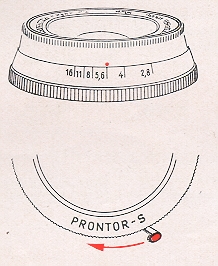 |
The lens aperture or diaphragm is
set by means of the front ring on the lens. Bring the red dot into register
with the black line at whatever setting is required.
Note:
The smaller the aperture number the more light is admitted, but the
more limited is the depth of field. The larger the aperture
number, the less light passes, but the greater the depth of field. For
example. f/2.8 passes more light than f/16 but the depth of field is
much less. |
Delayed Action Release for Self Portraitures
The delayed action release is fitted to the bottom of the
shutter and is set by moving the lever as far as it will go.
Warning: The
delayed action release cannot be used with "B" setting (time). It would
damage the shutter.
The Optical Exposure Meter
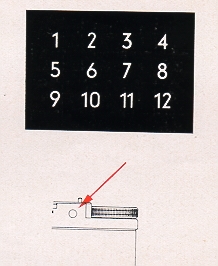 |
There are three rows of figures
of different density inside the exposure meter (right hand eye piece).
With the eye piece held close to the eye, aim the camera at the subject
to be taken. The highest figure which is discernible after looking through
the eye piece for about 20 seconds will be the light value and is the
basis for reading off the exposure time from the exposure tables on
the camera case. |
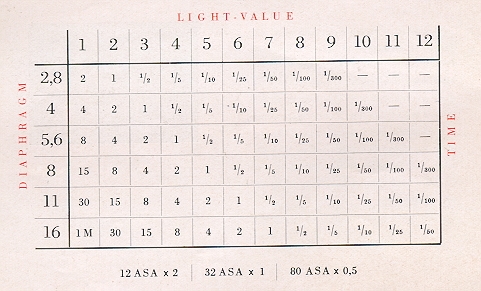
How to Read the Exposure Time from the Exposure Table
Example. Assuming that the figure 10 is the highest discernible
figure in the exposure meter, refer to the table which is attached to the back
of the camera case and look for figure 10 in the top horizontal row. The left-hand
vertical row, in front of the thick black line gives the apertures from the
2.8 to 16. It is then possible to read off the exposure times for each aperture
from the vertical row running down from the figure 10. Assuming that aperture
16 has been chosen (smallest aperture), the reading in the vertical line under
the figure 10 for aperture 16 will be 1/10 second. For aperture 11 an exposure
time of 1/25 second would be required, for aperture 8, 1/5n second, for aperture
5.6, 1/100 second and for aperture 4, 1/300 second. No exposure time for aperture
2.8 is given because for this light value (10) so large an aperture would be
unsuitable. The same procedure should be adopted for all other light values.
Note: The table is compiled for film with a sensitivity of 17/10 DIN.
For 21/10 DIN the exposure times should be halved and for 13/10 DIN they should
be doubled.
The corresponding values for other
sensitivity scales may be taken to be as follows:
| DIN |
SCHEINER |
WESTON |
ASA/BS |
21/10
17/10
13/10 |
31
27
23 |
64
25
10 |
12
32
80 |
How to Focus
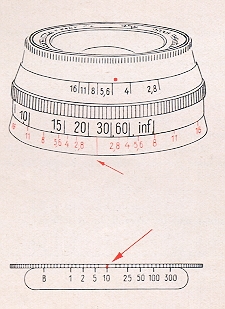 |
After estimating the distance between
the camera and the subject to be taken or after ascertaining it by means
of a range finder (which can be mounted on the camera), the second milled
ring situated on the lens is turned to register with the line which
will be found in the middle of the fixed ring engraved in red. The scale
of the distance setting ranges from 3'/2 ft. to infinity.
Exposure Time
The shutter is set
by bringing the red line on the milled ring of the shutter into register
with the desired speed which is engraved on the collar on top of the
shutter housing.
|
The Depth of Field
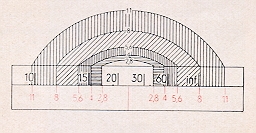 |
The depth of field
comprises the area which is sharply defined by the lens, from the foreground
to the background. This area or depth varies according to the aperture
chosen, that is to say, a large aperture (f/2.8) gives less depth of
field and a small aperture (f/16) gives a greater depth of field. The
depth of field for every aperture setting can be read off the red scale
on the middle ring of your Paxette. |
This repeats on the left and on the right on the
centre LINE, the range of lens apertures.
Examples . If the focus is set between 20 and 30 ft., everything
will be sharp from down 60 ft. to about 15 ft. when working with an aperture
of f/4. If working at f/8 however, everything will be sharp from infinity down
to 12.5ft.
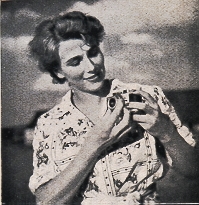 |
The Palette
should be held firmly in both hands so that
the rounded bottom edge is resting on the palms of the hands. When the
shutter is released, the left hand will then be keeping the camera steady.
The camera and the hand should be pressed against the head and a broad
stance adopted to ensure steadiness. Another point to observe is that
the ball of the right hand should exert slight counter pressure whilst
the second finger of the right hand presses the trigger.
|
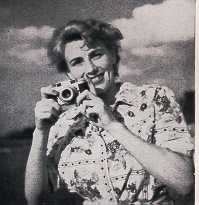 |
This should be done
gently and without jerking. Move the finger only and not the whole hand.
Allow the finger to rest on the release lever until the release has
run off. Remain calm whilst taking a picture especially when taking
snapshots with
the Paxette.
Good results amply repay the
trouble taken. |
If the Paxette should happen
to go wrong, the temptation to get a screwdriver and open it up should be resisted.
The correct assembly of, say, the shutter or the relationship of the lens to
the focal plane are most delicate matters, and even a skilled mechanic not accustomed
to cameras should hesitate. A faulty camera should not be touched but should
be handed to a good photographic dealer who has a specialist repairer with special
tools at his disposal.
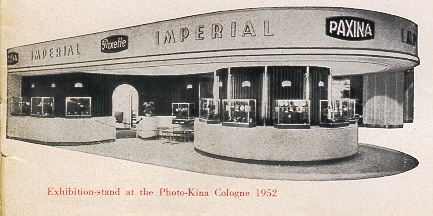
| Camera |
Format |
Lens |
Shutter |
| Paxette |
24 x 36 mm |
f/2.8
|
Pronter S 9 - speeds
delayed action : flash |
| Paxian I |
6 x 6 cm |
f/7.7 |
3 - speed (B - 1/25
- 1/100) |
| Pacian II |
6 x 6 cm |
f/3,5 |
Vario 4 - speed :
flash |
| Inperial Box |
cameras for 2 1/2"
x 2 1/2" |
and 2
1/4" x 3 1/4" with and without flash |
 ,
M. Butkus, NJ.
,
M. Butkus, NJ.