Kiev-60TTL
posted 2-12-'04
This camera manual library is for reference
and
historical purposes, all rights reserved.
This page is copyright©
by  , M.
Butkus, NJ.
, M.
Butkus, NJ.
This page may not be sold or distributed without
the expressed permission of
the producer
I have no connection with any
camera company
On-line camera manual library
If you find this manual useful,
how about a donation of $3 to:
M. Butkus, 29 Lake Ave.,
High Bridge, NJ 08829-1701
and send your e-mail address
so I can thank you.
Most other places would charge
you $7.50 for a electronic copy
or $18.00 for a hard to read Xerox copy.
This will help me to continue to host this site,
buy new manuals, and pay their shipping costs.
It'll make you feel better, won't it ?
If you use Pay Pal, use the link below.
Use the above address for a
check, M.O. or cash.
Back to main camera manual page
Click
here to KIEV-60TTL PDF version
made from this manual - better printing
KIEV-60TTL PDF version
made from different version of this manual
|
 |
Since efforts are continually made to improve the
reliability and performance of the product, minor changes may be introduced
without special notice.
CAMERA KIEV -60 TTL
1. GENERAL
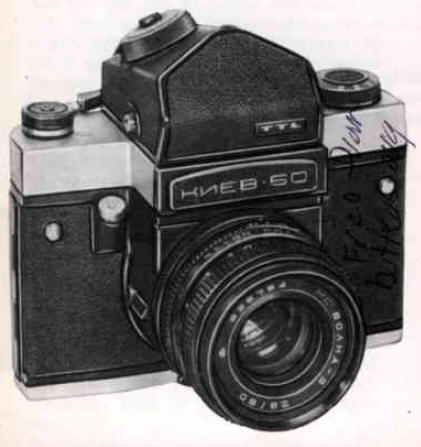
The KIEV-60 TTL is a reflex camera with
frame size 6x6 cm of the TTL system. The camera is designed for the use of a
roll non-perforated photographic film of 61.5 mm in width, type 120 (122
pictures can be taken using this film). It is intended for amateur
picture-taking.
The camera operates in the temperature interval from minus
15 to plus 45 °C.
The curtain shutter of the camera provides speeds in the
range of 1/1000 to 1/2 s and manual exposure "B".
The shutter winding
mechanism is of the lever type, interlocked with the film-transport mechanism
and frame counter.
The camera is focused through a ground glass surface,
microscreen and wedges located in the centre of the field of vision of the view
finder. The back of the camera is thrown back on a hinge.
The scale of the
frame counter returns into its initial position automatically when the back of
the camera is opened. The camera is provided with a synchronizer for operation
with a flash lamp.
The camera is outfitted with lens ARSAT C. The lens
focal length is 80 mm, the relative aperture is L2.8, the diaphragm setting
limit is 22. The lens is provided with the special multilayer coating (MC) which
upgrades the image quality, enhances its contrast due to better integral
transparence and reduced light dispersion of the lens.
Provision is made
in the camera for the use of change lenses produced for the KIEV-6C camera.
Change lenses of the PENTACON SIX camera can also be used. The lenses are
bayonet-attached and are fixed in position with a captive nut. Besides the TTL
prismatic view finder the camera complete
set comprises a view finder
hood.
The view finder hood enables the picture to be viewed on the
ground glass with or without a magnifying lens and allows the use of the frame
view finder for viewing. The field of vision
of the view finder hood
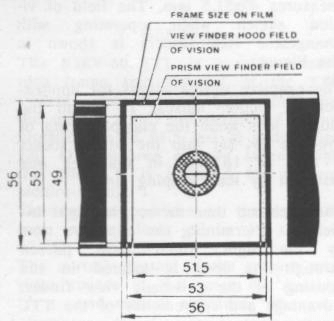
measures 53x53 mm.
Magnification of the prismatic finder eyepiece is 2.5x,
the field of vision measures 49x51.5 mm. The field of vision sketch when
operating with changeable view finders is shown in the Figure.
The
eyepiece design allows for application of diopter lenses. To install the diopter
lens undo the clamping ring of eyepiece 39, set into the fitting socket a tens
of 16 mm in diameter and fasten it by the clamping ring.
 |
The exposure time meter with light indication determining the
exposure time by the light which have passed through the lens is located in the
housing of the prismatic view finder. Advantage and convenience of the TTL
measurement system is in automatic control of all factors affecting the value of
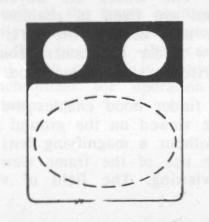
the exposure time. The zone of measurement of the exposure time
meter is
in the central part of the view finder field of vision and has an oval shape (
see the Figure ).
The exposure time meter ensures measurements in the
range of brightness from 2 to 16 000 cd/m2, in this case the following values
should be taken into account: film-in-use speed (6 to 3200 units of ISO),
exposure time (1/1000 to 8 s) and diaphragm (1.4 ... 32).
76. |
 |
A battery with initial voltage of 4 to 4.5 V (dia. 11.6 mm,
length 16.2 mm) is used as a power source of the exposure time meter. The
battery may comprise, for example, three cells type PX675, RM675 or MS |
2. LIST OF STANDARD EQUIPMENT |
Camera with lens ARSAT C 2.8/80, prismatic
view finder TTL with eye shade and spool (set)
View finder hood
Light filters:
Y4)-IN (UV-1") or 0-2,8" (0-2.8")
)K3-1,4" (YG-1.4")
Extension tube:
20 mm long
40 mm long
Lens front cap
Lens rear cap
Blind cap for camera . . . .
Direct-type view finder
cap . .
Carrying (shoulder) strap
Arm
Lens hood
Carrying
case
Instructions for Use
Packing box |
1
1
I
1
1
1
1
1
1
1
1
1
1
1
1
1 |
3. CAMERA PRINCIPAL UNITS AND PARTS
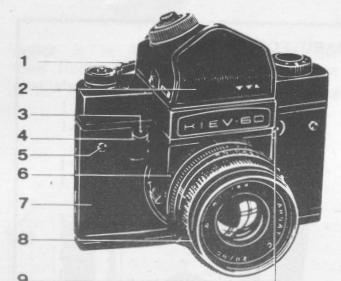 |
1 - shutter winding lever;
2 - prismatic view finder
TTL;
3 - straight thread
fastening socket;
4 - release button;
5 - button for fastening the strap;
6 - lens-locking-in-position captive nut;
7 - housing;
8 - lens;
9 - arm fastening socket for flash lamp; |
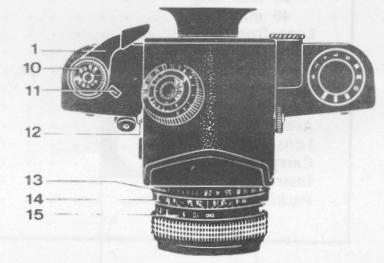 |
10 - film-in-use speed scale;
11 - frame counter window;
12 -• view finder lock button;
13 - diaphragm scale;
14 - diaphragm scale for
determining
depth of field;
15 - distance scale; |
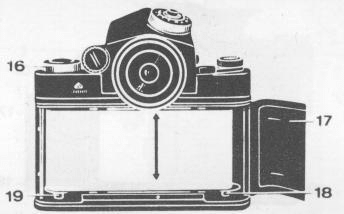 |
16 - exposure time knob;
17 - back;
18 - centre for fitting take-up spool;
19 - centre for filling film spool; |
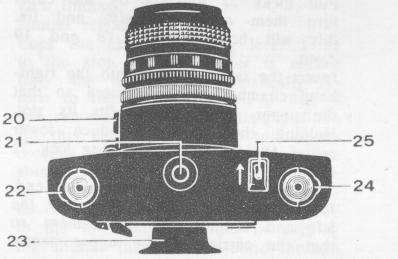 |
20 - depth-of-field control lever;
21 - tripod socket;
22 - take-up spool lock;
23 - replaceable eye shade;
24 - delivery spool lock;.
25 - back lock. |
4. OPERATING PROCEDURE
4.1 Loading
The camera can be loaded in the light (preferably in
the shadow). Take the camera out of the carrying case. Open back
17 having preliminarily shifted along the arrow up to the stop
and depressed button
25 located on the lower cover.
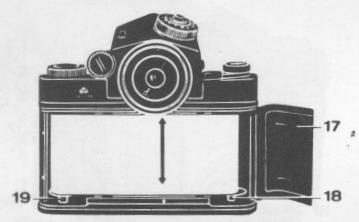 |
Pull locks 22 and 24 by the
clips, turn them counterclockwise and fix, this will bring centres
18 and 19 down.
Insert the take-up spool
into the right hand chamber of the camera so that the upper centre carrier fits
its slot. Holding the spool, introduce lower centre
18 into its hole turning lock 22 clockwise. |
Tear the paper tag off the leader end. Insert
the spool with a film into the left-hand chamber of the camera so that the
carrier of the upper centre
enters the spool slot. Holding the spool and
leader by a hand to prevent them against unfolding, put lower centre
19 into the spool hole, turning lock 24
clockwise.
Thread the leader end into the take-up spool and turning the
latter wind the leader onto it until the mark on the leader aligns with the red
index on the camera housing. To obtain the full specified number of pictures on
the film and to ensure operation of the frame counter observe the following
rules:
when loading wind the leader tightly on the take-up spool; take
measures against leader skewness, creeping over the spool flange or crumpling
leader edges; winding the shutter, take care to bring the lever to the stop in
one motion (do not wind the shutter, making several small turns of the lever).
Close the back pressing it to the camera until a click is heard.
4.2. Preparing for Shooting
Make three blank shots to
wind the leader onto the take-up spool. Now after the shutter is wound the next
time figure "l" will appear in frame counter window 11 which corresponds to the
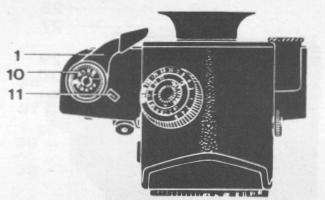
first frame on the film. Set the film-in-use speed on scale 10, proceeding as
follows: holding lever 1, turn the disk until the loaded film speed value
appears in the window. The film speed scale is given in units of ISO.
4.3. Shooting
 |
Shooting with the camera consists of the following steps:
shutter winding and film transport; determining the exposure time (shutter speed
and diaphragm);
exposure time setting;
diaphragm setting;
focusing;
view finding;
shutter release. |
Wind the shutter, turning lever 1
up to the stop. If the shutter is wound fully, the lever will automatically
return to the initial position, if not, it will remain in an intermediate
position (in this case it should be additionally wound). An incomplete winding
of the shutter should be avoided. At the beginning of wind the shutter a slight
gradient of force applied to the lever may be fell. In winding the shutter the
film is wound through 0 one frame and the next number appears in the frame
counter window. The counter indicates the number of frames shot.
Determination of the exposure time is carried out with the shutter being wound.
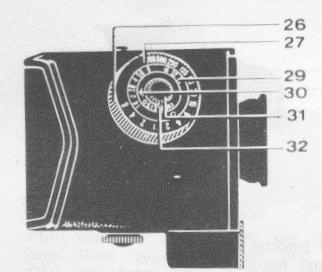 |
For determining the exposure time set on the calculator the
speed of the film loaded into the camera turning knob 31 until the film speed
value in units of ISO appears in window 32.
Note: In connection with the
introduction of a new series of the film sensitivity numbers expressed in units
of GOST/ISO it is essential to use the Table given below in setting the film
sensitivity_ values on the calculator. |
Scale marking,
GOST/ISO |
Film sensitivity number of
photographic material being used |
| GOST/ISO (ASA) |
DIN |
| 6 |
5: 6; 8 |
9 |
| 12 |
10; 12; t6 |
12 |
| 25 |
20; 25; 32 |
15 |
| 50 |
40; 50; 64 |
18 |
| 100 |
80; 100; 125 |
21 |
| 200 |
160; 200; 250 |
24 |
| 400 |
320; 400; 500 |
27 |
| 800 |
640; 800; 1000 |
30 |
| 1600 |
1250; 1600; 2000 |
33 |
| 3200 |
2500; 3200; 4000 |
36 |
Set on the calculator the lens speed turning
scale 29 unlit the appropriate value coincides with index 30.
The lens speed means the number corresponding to the maximum relative
aperture. For example, for lens ARSAT C - 2.8.
For determining the
"exposure-diaphragm" pair corresponding to the shooting conditions do the
following procedures:
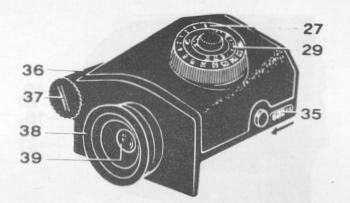
turn on the exposure time meter having depressed
key 35 in the direction indicated by the arrow. Upon turning on, release the
key.
 |
The exposure meter will operate for 15s, then it will
automatically turn off; observing through view finder eyepiece
39 sight the camera onto (he object of shooting so that its
image will arrange in the ranges of the zone of measurement of the view finder;
in the field of vision of the view finder eyepiece You will see one of red
lighting signals: the left-hand signal - "little light" or the right-hand -
"much light". |
 |
Slowly turn ring 26 up to the moment of
lighting of the second signal (if the left-hand signal is lit -
counterclockwise, if the right-hand clockwise). |
Determination of the exposure time is carried
out at simultaneous lighting of the signals; choose (he "exposure-diaphragm"
pair which is necessary for shooting on the calculator by exposure scale
27 and by diaphragm scale
29.
Note: In the event of the bright light the light should not
be permitted, as far as possible, to penetrate into the eyepiece. In this
instance eye shades
38 and 23 should be used.
Set the chosen "exposure-diaphragm" values on the camera exposure time knob
scale and on the lens diaphragm scale.
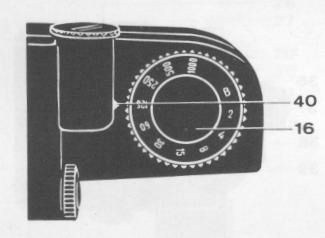
Exposures maybe set
both with the shutter released and winding turning knob
16
until the selected number aligns with index
40 on the top cover. Setting of exposures from 1/1000 to
1/60 s with the shutter released requires somewhat more effort than when the
shutter is wound.
Manual exposure "B" setting should be accomplished
by turning the knob clockwise only (between shutter speeds 1/1000 s and "B"
the ring is locked).
Set the diaphragm, turning ring
13 until the selected value aligns with the index on the
stationary ring. The scale is fixed at all diaphragm values.
Focusing
either by the ground glass surface, microscreen and wedges or by the
distance scale, is accomplished, turning the ring with scale
15. Focusing can be carried out only with the shutter
wound, when the mirror is in the working position and the diaphragm the
fully open.
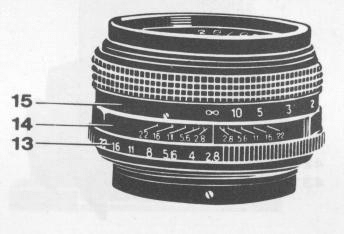 |
Depth of field is determined by the distance scale with the aid
of additional scale
14. Depth of field can be checked by the image of the objects
details on the ground glass surface in the field of vision of the view finder,
after pressing lever
20 down to the limit of its travel, then the lens will be
diaphragmed to the opening set previously. When released, the lever will
automatically return to the initial position and the diaphragm will fully open. |
 |
Depending on the definite conditions of the picture shooting,
sighting can be carried out by the use of the view finder hood.
To
replace the TTL prismatic view finder by the view finder hood proceed as
follows:
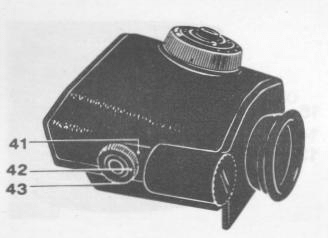
turn ring
43 clockwise until it aligns with indexes 42
and
41. Depress buttons 12, lift the TTL prismatic
view finder up;
set view finder hood
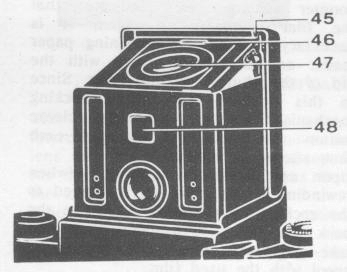
45 on the guide pins (in so doing make certain that it is well
secured on the camera). |
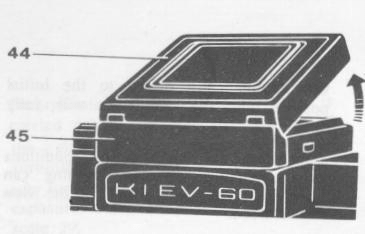 |
Open the view finder hood, turning front wall 44
in the direction of the arrow illustrated in the Figure. in its end position the
front wall of the hood is locked and the side and rear walls are automatically
folded down. When lock lever
46 is shifted up, view finder magnifying lens 47
is set to the working position. |
Upon completion of shooting with the aid of the view
finder hood, press the view finder magnifying lens wall to the front wall of the
view finder until the indexing lever snaps it in, then fold up the side walls
(first left-hand, then right-hand), then the rear wall, and holding the latter,
return the front wall into the initial position.
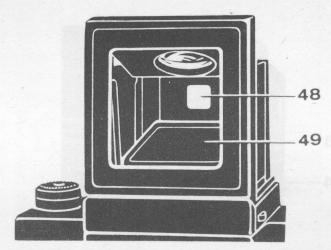
In prompt shooting
(such as sports photography) the view finder hood can be used as a simple frame
view finder. Then window
48 in the rear wall of the view finder hood will serve as one
frame and the window in the front wall, closed in the non-working position with
cover
49, as the other.
 |
The cover, when depressed, will turn and lock in the end
position.
In shooting with the frame view finder focusing is effected
either by the use of lens distance scale
15 or by the ground glass through the eyepiece. To fold down
the frame view finder depress the wall of view finder magnifying lens
47, in this case cover 49 will return to the
initial position. |
 |
After folding down the frame view finder, close the view finder
hood as explained previously.
To release the camera shutter, gradually
depress release button
4 up to the stop. During this action the lens will close the
diaphragm, the mirror automatically rises and the shutter operates. |
Shooting with exposures in excess of
1/30 s should be performed by the use of the tripod. The tripod socket in the
camera is provided with the 3/8"
thread.
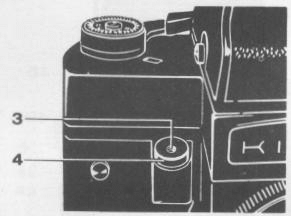 |
The shutter is released with the aid of the straight thread
which is screwed into socket
3 of the release knob. |
4.4. Unloading the Camera
Shooting can be carried out until the "K" letter (end) appears in the frame
counter window which indicates that the film is used up. Then it is necessary to
wind the remaining paper leader on the take-up spool with the aid of the shutter
winding lever. Since in this position the shutter winding mechanism is
disconnected, the release button may not be depressed each time after winding.
Upon completion of rewinding (when rewinding is over, the force applied to the
winding lever diminishes) open the back of the camera, move out the take-up
spool centre and remove the spool with the used film.
5. REPLACING THE LENS
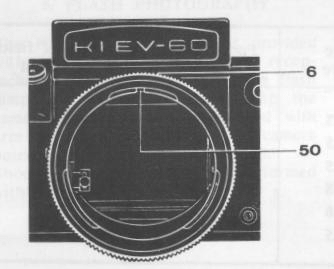 |
The camera is adapted for the use of interchangeable lenses. To
remove the lens turn nut
6 counterclockwise up to the stop and disconnect the lens from
the camera. |
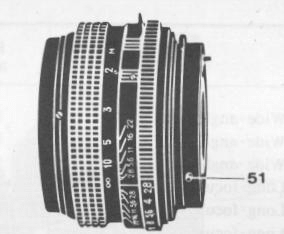
When installing the lens, it is necessary to fit it into
the camera so that guide pin
51 of the lens gets into slot 50 on the camera
housing. Then turning the nut clockwise to the limit of its travel clamp the
lens on the housing.
 |
The following ARSAT C interchangeable lenses are produced for
the KIEV-60 TTL camera: |
| Lens |
Relative
aperture |
Focal length,
mm |
Angle of field
of vision |
| Wide-angle |
1 : 3.5 |
30 |
180' |
| Wide-angle |
1 : 3.5 |
45 |
83' |
| Wide -angle |
1 3.5 |
65 |
66' |
| Long-focus |
I 2.8 |
120 |
36' |
| Long-focus |
1 : 2.8 |
150 |
28' |
| Long-focus |
1 : 3.5 |
250 |
19' |
6. FLASH PHOTOGRAPHY
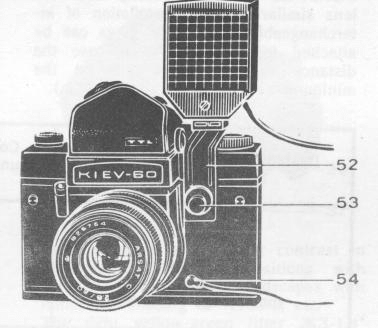 |
The KIEV-60 TTL camera is provided with the synchro contact with
receptacle
54 for the connection of a flash lamp. To install the flash
lamp the camera complete set is provided with arm
52 which is fixed to the camera housing with the aid of screw
53. Shooting with flash lamp is performed with exposures from
1/30 to 1/2 s. |
7. MACROPHOTOGRAPHY
Close-up photography of small objects (macrophotography) can be accomplished
using rings supplied with the camera in the set of spare parts and accessories.
The use of the rings enables to make shooting at a distance less than 0.6 m
which is minimum for the ARSAT C 2.8/80 lens.
The rings are installed
as required between the camera housing and the lens similarly to the
installation of interchangeable lenses. The rings can be attached together (in
which case the distance to the object will be the minimum and make up about 0.3
m).
When operating with the view finder hood and when using the rings,
increase the exposure time found with the aid of the exposure meter in
accordance with the data given in the Table.
| Designation of ring fitted on the camera, mm |
Coefficient of increase of exposure time
found with the aid of exposure meter (with lens distance scale set to 0.6
m) |
| 20 |
2" |
| 40 |
3" |
60
(both rings together) |
3.5" |
During operation with the TTL prismatic view finder
influence of the rings on the value of the exposure time is taken into account
automatically.
8. INSTALLATION AND REPLACEMENT OF POWER SOURCE
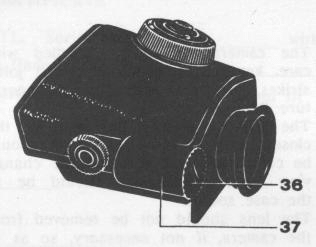 |
Unscrew lid 37 with the help of a coin
installed into the slot of the lid. Set the power source in socket 36 locating
it with its plus side to the lid
(on the internal side of the cover mark
"+" is engraved). |
9. USE OF LIGHT FILTERS
The camera set is provided with light filters used as attachments which can be
screwed into the front part of the lens mount (thread M62x0.75). The achromatic
light filter YD-lx (UV-IX) is used for weakening the effect of ultraviolet rays,
for example, when taking pictures under high mountain conditions, it is also
helpful in colour photography.
Light filter 0-2,8X (0-2.8") is orange one,
fully absorbs ultraviolet rays. It is used to obtain a particular contrast in
photographing the compositions with clouds, water surfaces, landscapes with
noticeable shading of verdure, etc. The light yellow-green filter 3K3-1,4=
(YG-l,4") improves tone reproduction of multicolour objects on high-sensitive
photographic materials with a slight loss of their sensitivity. With medium
sensitive photographic materials the practically correct tone reproduction of
multicolour objects is attained.
10. CAMERA UPKEEP
The camera should be handled with
care, kept clean, guarded against jolts, strikes, moisture and abrupt
temperature fluctuations.
The camera should be kept in the closed carrying
case. The lens should be closed with the cap and the change view finder
attachment should be in the case socket.
The lens should not be removed
from the camera, if not necessary, so as to keep dust off the surface of the
optical parts. If the camera is stored without the lens, the aperture in the
camera as well as the lens should be closed with caps.
Wipe the surfaces
of the optical parts with clean soft cloth or with cotton slightly wetted in
rectified spirit or ether.
When bringing the camera into a warm room from
frosty weather do not
take it out of the case at once. Let it warm
gradually (for two hours) in the case.
Do not exert excessive force in
manipulating the camera. In case of some troubles or damage do not attempt
repairing the camera by yourself. The camera must be repaired or adjusted only
by specialists.
Important ! The camera curtains are made from light-tight
rubberized fabric and to preserve it against deterioration the following
measures should be taken in shooting in the sun: remove the lens cap and open
the view finder hood immediately before shooting:
do not direct the camera
lens towards the sun;
do not leave the camera in the sun during long-term
outage between shootings.