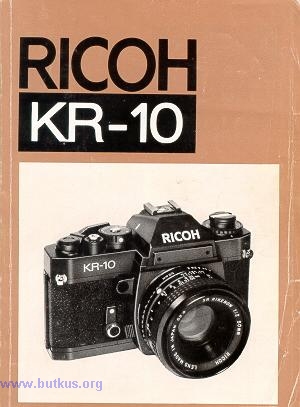
Ricoh KR-10
(XR-1000X / KR-10se)
This camera manual library is for reference
and historical purposes, all rights reserved.
This page is © 2024 by M. Butkus, NJ.
This page may not be sold or distributed without the
expressed permission of the producer
On-line camera manual library
If you find this manual useful,
how about a donation of $3 to:
M. Butkus, 29 Lake Ave.,
High Bridge, NJ 08829-1701
and send your
e-mail address
so I can thank you.
Most other places would charge
you $7.50 for a electronic copy
or $18.00 for a hard to read Xerox copy.
This will help me to continue to host this site,
buy new manuals,
and pay their shipping costs.
It'll make you feel better, won't it ?
If you use Pay Pal, use the link below.
Use the above address for a
check, M.O. or cash.
Back
to my main camera manual page
Click here
for a Ricoh KR-10 PDF
- - English - -
Ricoh KR-10 Mode d'emploi
Direct from manual
Ricoh KR-10
Bedienungsanleitung
Ricoh KR-10 Manual de Instrucciones
Click here for Ricoh KR-10
PDF version from HTML - better printing
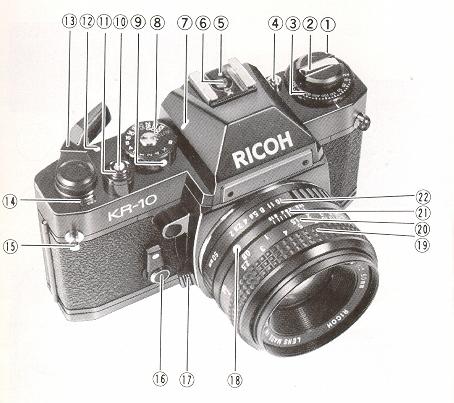
DESCRIPTION OF PARTS
|
1. Film Rewind Knob/Back Cover Lock Release Knob
2. Film Rewind Crank
3. Film Speed Dial (ASA) /Exposure Compensation Dial
4. Film Speed Lock Button
5. Flash Ready Signal Contact
6. Hot Shoe/Flash Contact
7. Shutter Speed Index Line
8. Shutter Speed Dial
9. Automatic Exposure Lock Button
10. Cable Release Socket
|
|
11. Shutter Release Button
12. Shutter ''ON-OFF'' Index Mark
13. Film Advance Lever
14. Exposure Counter
|
15. Neck Strap Eyelet
16. Self-timer Lever
17. Lens Release Lever
18. Lens Locator Node
|
|
19. Focusing Ring
20. Distance Scale
21. Depth of Field Scale
22. F-Stop Ring
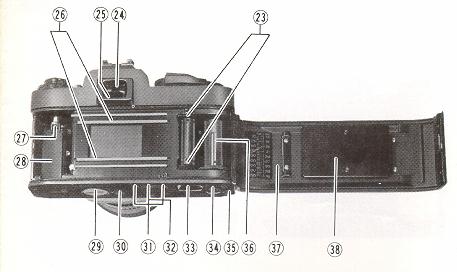
23. Sprocket Teeth
24. Viewfinder Eyepiece
25. Flash LED
26. Film Rail
|
|
27. Film Rewind Shaft
28. Film Chamber
29. Battery Compartment Cover
30. Tripod Socket
31. Winder Contacts
32. Shutter Release Connection
33. Film Rewind Release Button
34. Winder Coupler
35. Positioning Hole
|
36. Film Take-up spool
37. Back Cover
38. Film Pressure Plate
39. Microprism-image Band
40. Split-image Spot
41. Exposure Meter Needle
42. Shutter Speed Indicator
43. Viewfinder Eyepiece
|
We are most gratified that you have selected the KR-10
which we are sure will give you many delightful! years of picture-taking
pleasure. The KR-10 is a 35 mm fully automatic electronically controlled
exposure system (aperture-priority) SLR camera which assures you of superb
optics and outstanding mechanical performance and reliability and which will
justify your choice for years to come.
Before Using Your KR-10
Please read this instruction booklet carefully and
familiarize yourself with the equipment and its features thoroughly Your
pleasure in using your KR-10 will be greater if you know your camera properly.
BATTERY LOADING
The built-in through-the-lens CdS exposure metering
system of your KR-10 operates on power activated by two 1.5V LR-44 alkaline
batteries. which are supplied together with your camera.
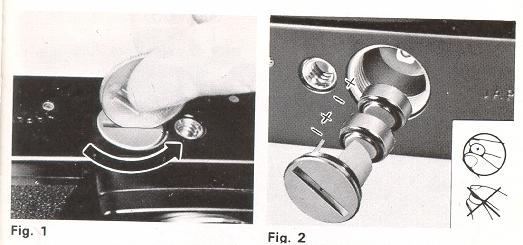
1. Remove Battery Compartment Cover (29) by
unscrewing it counterclockwise with a coin (Fig. 1).
2.
Place the two
batteries into the compartment with the plus 03 side down, as illustrated in
the battery holder of Battery Compartment Cover (29) (Fig. 2) Make sure that
the batteries are correctly placed. If incorrectly placed. Exposure Meter
Needle (41) in the viewfinder will not move at all.
3.
Replace Battery Compartment Cover (29) by screwing it clockwise until it
stops but do not force.
Tips for Better Results
* If the shutter release button is pressed when
there are no batteries or they are worn out, the mirror will stay up and the
shutter cannot be released. To put the mirror back to its proper position,
turn the shutter speed dial to ''X'' or ''B'', and be sure to insert new
batteries immediately. If you wish to take pictures without using
batteries, use "X'' (1/90 sec.) or ''B''.
* Before loading, wipe off the surfaces of the batteries
with a clean and dry cloth to ensure they are free of fingerprints or stains
* When your camera is not used for a long period.
remove the batteries and keep them in a cool. dry place
* The batteries will last for about half a year in normal
use.
* The batteries may explode if disposed of in fire
FILM LOADING
Your KR- 10 is designed to accept any standard 35 mm color
or black and white film roll in cartridge. (12, 20, 24 or 36 exposures).
1.
First of all. press Shutter Release Button (11) to
see that the shutter has been released.
(Refer to "METER/SHUTTER ON OFF CONTROL").
2.
Pull up Film Rewind Knob
(1) until Back Cover (37) snaps open (Fig. 3). Then, pull it out all the way to
allow for insertion of the film cartridge.
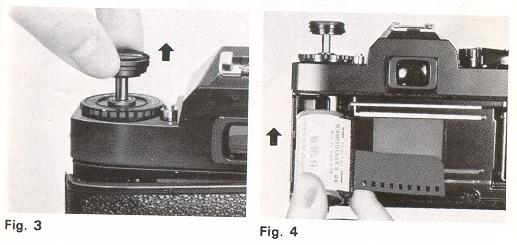
3.
Swing open Back Cover (37) and place a film cartridge
into Film Chamber (28) (Fig. 4).
4.
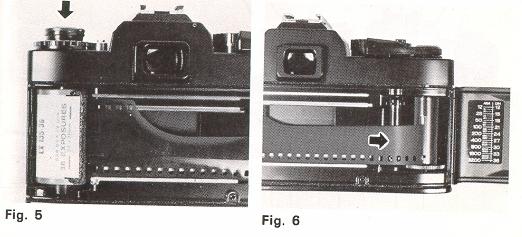
Push down Film Rewind
Knob ( 1 ) to its original position by turning Film Rewind Crank (2) clockwise
or counterclockwise so that Film Rewind Shaft (27) engages the film cartridge
and that the film cartridge is seated in place (Fig. 5).
5.
Draw the film
leader across the camera back and insert it into one of the slits of Film
Take-up Spool (36) (Fig. 6). To bring the slit into a convenient position.
rotate Film Take-up Spool (36) in the direction of arrow with your finger.
6.
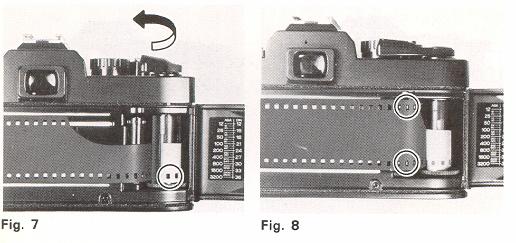
Rotate Film
Take-up Spool (36) by advancing Film Advance Lever (13) to take up any slack
in the film and check to see that the film tip is firmly hooked onto Film
Take-up Spool (36) (Fig. 7) and that sprocket holes on the film are fully
engaged on Sprocket Teeth (23) (Fig. 8).
7.
Close and press Back
Cover (37) firmly until it snaps shut.
8.
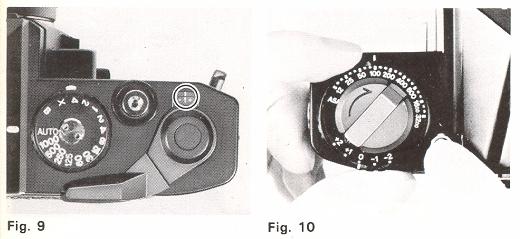
Advance Film Advance Lever (13) two or three times,
after depressing Shutter Release Button
(11) each time, until the number "1" is opposite the
index line in Exposure Counter (14) (Fig. 9), because the first portions of
the film can not be used for picture taking as they have already been
exposed to light and two or three blank exposures should be made before
taking your first picture. Now it is ready for your first picture.
Tips for Better Results
*
Always load your camera in the shade or in a poorly lit
peace, never in direct sunlight or other bright light.
*
As you advance the Film Advance Lever (13). the Film
Rewind Knob (1) will simultaneously rotate counterclockwise indicating that the
film is advancing properly.
*
When making blank exposures with Shutter Speed Dial (8)
set at "AUTO", set F-Stop Ring (22) to the smallest f-stop (the largest lens
opening) so that you can make next blank exposure quickly, otherwise a slower
shutter speed will be result which could be an annoyance.
SETTING FILM SPEED
Each type of film, color or black and white, has its own
sensitivity to light. This sensitivity is assigned by a numerical value
described as an ASA rating (U.S.A. Standard) or a DIN rating (Europe and most
other countries). In most cases, both ASA and DIN ratings are imprinted on the
film package, as well as the data sheet packed with the film and the film
cartridge itself. The higher the film speed rating, the more sensitive the film
is to light: that is, less light is required for a proper exposure. The film
speed. therefore, is an important element in insuring that the through-the-lens
metering system of your camera determines the correct shutter speed and f-stop
combinations for a given lighting situation.
1. Depress Film
Speed Lock Button (4) (Fig. 10) and rotate Film Speed Dial (3) until the ASA
number of your film is exactly opposite the index line and click stops. For
example, if the film is ASA 100, make the correct setting at ''100" (Fig.
11).
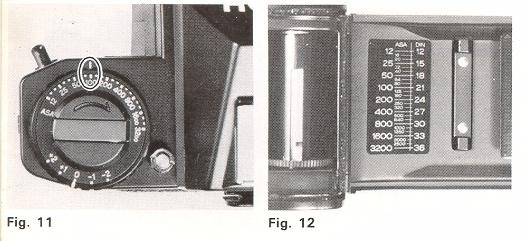
2. Take your finger
off Film Speed Lock Button (4) to lock the film speed setting in the camera.
Tips for Better Results
*
Each time a film with a new film speed rating is
loaded in your camera, the film speed must be set to assure accurately
exposed photographs
*
The scale represents the
relation between ASA and DIN numbers is illustrated on the inside of Back
Cover (37) (Fig. 12).
METER/SHUTTER "ON-OFF" CONTROL
Film Advance Lever (13) controls shutter release
"LOCK-UNLOCK'' to protect your camera from accidental shutter release when not
taking pictures and Shutter Release Button ( 11 ) controls exposure meter
''ON-OFF'' to avoid unnecessary depletion of the batteries.
1.
When Film Advance Lever (13) is moved to "ON''
position (Fig. 13),
Shutter Release Button (11) is unlocked.
2.
When Shutter Release
Button ( 11 ) is pressed half way down, the electric
circuit is switched on and Exposure
Meter Needle (41) in the viewfinder starts to move.
Tips for Better Results
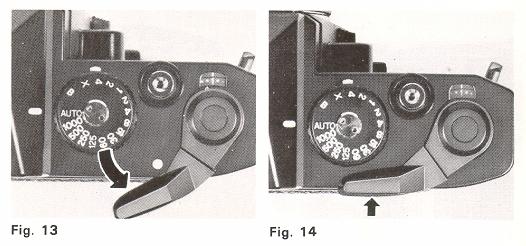
*
Whenever picture-taking is completed. be sure to move
Film Advance Lever (13)
to ''OFF'' position (Fig. 14).
*
To prevent unnecessary consumption of the batteries, do
not press Shutter Release
Button (11) often.
*
The Film Advance Lever can be set at two angles in click
stage positions.
Choose the one suitable for your own
shooting style.
SETTING SHUTTER SPEED DIAL
The shutter controls the length of time the light is
allowed to strike the film The speed at which the shutter opens and closes is
measured by the numbers on Shutter Speed Dial (8). In automatic exposure
operation, correct shutter speed is set automatically
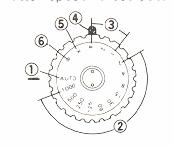
*
Simply turn Shutter Speed Dial (8) until the desired
shutter speed is set opposite
Shutter Speed Index Line (7).
(1)
"AUTO" stands for AUTOMATIC Setting the dial at "AUTO''
makes the camera ready
for automatic exposure control.
(2)
The numbers 1000, 500 etc. to 2 stand for 1/1000 sec.
1/500 sec., etc. to 1/2 sec.
(3)
The numbers 1, 2, 4. stand for 1 sec 2 sec., and 4 sec.
(4)
This button locks the dial at "AUTO" setting When you
move the dial off " AUTO". press
the button and
rotate the dial.
(5)
''X" stands for mechanical shutter for the speed of 1/90
sec. This setting is used when the
batteries have
not sufficient power or taking picture without batteries.
Flash
photography is also possible at this setting.
(6)
"B" stands for Bulb. The "B'' setting is used for long
night exposure using street lights or
electric signs
as a light source. or under poor lighting conditions when flash can not be used.
When set at
''B'', the shutter will remain open as long as Shutter Release Button (11) is
depressed
(preferably by
a cable release)
Tips for Better Results
*
Do not set Shutter Speed Dial (8) between marked
speeds, but at a click stop in accordance with indicated speeds only.
*
Shutter Speed Dial (8) does not revolve between "AUTO''
and "B''.
*
When Shutter Speed Dial (8) is set at "B" or "X", set the
desired f-stop and expose manually because metering with the built-in exposure
meter is not possible.
*
When making extremely long
time exposure at "B" setting, remove the batteries to avoid unnecessary
consumption of the batteries.
SETTING APERTURE
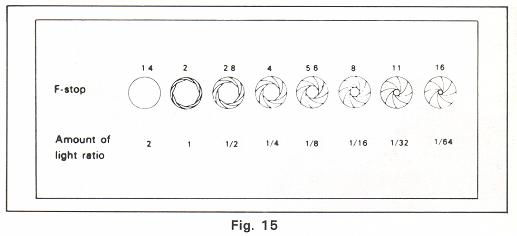
The lens opening determines the amount of light entering
the lens and exposing the film. The smaller the f-stop (f/2.0. f/2.8 etc.), the
wider the lens opening and the greater the amount of light entering the lens.
The larger the f-stop (f/16. f/11 etc.). the smaller the lens opening and the
smaller the amount of light entering the lens. As the lens opening is moved from
f/16 to f/1 1, the amount of light entering the lens is doubled. As the lens
opening is moved from f/2.0 to f/2.8, the amount of entering light is cut in
half (Fig. 15).
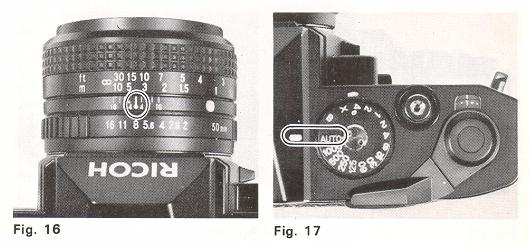
*
Rotate F-Stop Ring (22) until the desired f-stop is
opposite the aperture index line (Fig. 16). Click stops are provided to prevent
accidental movement from the setting made.
Tips for Better Results
*
If necessary, you may set
F-Stop Ring (22) between two f-stops.
CORRECT EXPOSURE - Automatic Exposure
Your KR-10 has a built-in through-the-lens full aperture
CdS exposure meter coupled to aperture-priority automatic exposure control
system which selects and sets correct shutter speed automatically for correct
exposure.
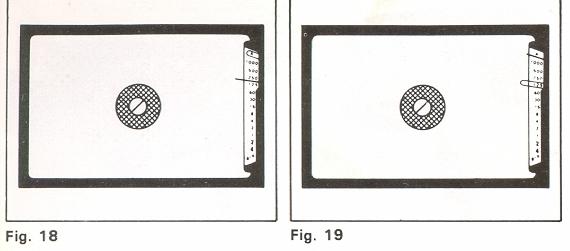
Set the camera to "AUTO"
1.
Turn Shutter Speed Dial (8) until the ''AUTO" is set
opposite
Shutter Speed Index Line (7) (Fig. 17). Shutter Speed
Indicator (42) in the viewfinder indicates "A", showing that the camera is set
for automatic exposure control (Fig. 18).
Preselect the aperture
2.
Preselect the desired aperture by rotating F-Stop Ring
(22). For preselecting the aperture, refer to the following rough guide when
using ASA 100 film.
Outdoors in bright sunlight . . . . . . . f/8.0 -
f/16
Cloudy weather or in shade . . . . . . f/2.8 - f/5.6
Indoors . . . . . . . . . . . . . . . . f/1.4 - f/4.0
Exposure checking
3.
After moving Film Advance Lever (13) to "ON" position.
press Shutter Release Button ( 11 ) lightly half way down until the Exposure
Meter Needle (41 ) begins to move.
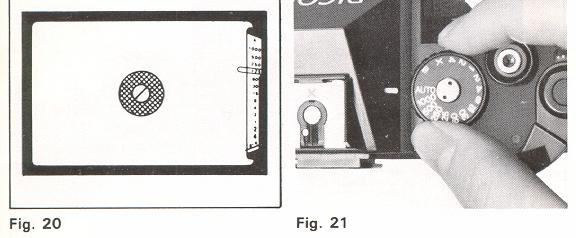
The Exposure Meter Needle (41 ) in the viewfinder
indicates the shutter speed you will be shooting at:
["1000" is 1/1000 sec., "125" is 1/125 sec.. "4" is 1/4
sec., "1 " is one full second and " a' " is 2 seconds]
If the needle goes above "1000" (Fig. 19), close down the
aperture until the needle moves below "1000". If the needle goes below "B. X."
(Fig. 20). open up the aperture until the needle moves above "B. X.".
Tips for Better Results
*
At slow speeds (below 1/30 sec.). use a tripod or other
firm support to prevent camera movement and blurred pictures. In shooting with a
telephoto lens, be careful to minimize the camera shake especially.
When using
telephoto lenses, a good rule of thumb is ''use a shutter speed faster than
1/focal length of the lens''.
For example, with a 135 mm lens, use a shutter speed
faster than 1/125 sec. Otherwise, a tripod is suggested.
*
Coupling range of the exposure control for ASA 100
film is from 1/2 sec. at f/2 to 1/1000 sec. at f/11 (EV3 - 17).
*
The shutter speed is automatically determined at any
speed within the range of
approx. 8 sec. to 1/1000 sec..
according to the lighting conditions of your subject.
Manual Exposure
Manual exposure setting is used when taking flash
photography or when you wish to preselect the shutter speed.
1.
Press Automatic Exposure Lock Button (9) and move
Shutter Speed Dial (8) off "AUTO''
(Fig. 21). Then. set the desired shutter speed
opposite Shutter Speed Index Line (7) by
rotating Shutter Speed Dial (8). Shutter Speed
Indicator (42) in the viewfinder indicates
the shutter speed you just set.
2.
Move Film Advance Lever (13) to "ON'' position.
3.
Hold your camera, look at your subject through the
Viewfinder Eyepiece (24) and press
Shutter Release Button (11 ) lightly
half way down.
4.
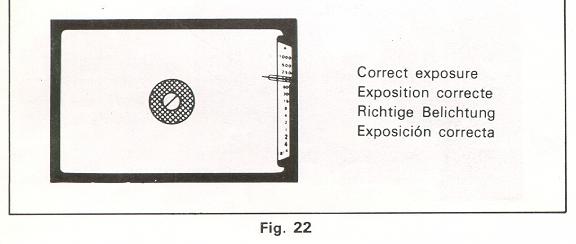
While keep pressing Shutter Release Button ( 11 )
half way down, rotate F-Stop Ring (22) and align Exposure Meter Needle (41)
with Shutter Speed Indicator (42) (Fig. 22).
If Exposure Meter Needle (41 ) goes above Shutter Speed
Indicator (42), this means "overexposure'': select a faster shutter speed or a
smaller lens opening.
On the contrary, if the needle goes below Shutter Speed
Indicator (42), this means ''underexposure": choose a slower shutter speed or a
larger lens opening.
(Web Master: Using the above instructions, you can
then change the shutter speed for any special effects and then the F-stop to
make a correct exposure. You can also choose an F-stop [for a special effect]
and then use the meter to make a correct exposure.)
EXPOSURE COMPENSATION DIAL
The dial is used when exposure compensation (intentional
over- or under-exposure) is necessary in AUTOMATIC EXPOSURE operation. In
unusual lighting conditions. the desired effect or the correct exposure will not
be obtained in the final picture and exposure compensation is necessary.
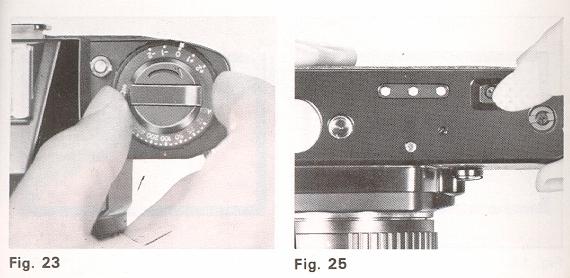
*
Lift up the outer ring of Exposure Compensation Dial (3)
and rotate it until the index line on the ring is opposite the corresponding
number (+2, + 1, - 1, - 2) and click stops (Fig. 23).
When the light is behind the subjects: Set the dial at + 1
or +2.
Spot-lighted subjects and dark backgrounds: Set the dial
at -1 or -2.
Tips for Better Results
*
When exposure compensation is unnecessary. be sure to
set Exposure Compensation
Dial (3) at ''O''
*
Do not set Exposure Compensation Dial (3) between marked
numbers, but at a
click stop in accordance with
indicated numbers only.
VIEWING AND FOCUSING
Since you are viewing through the lens, there is no
parallax problem.....
What you are viewing in the viewfinder will exactly appear
in your picture. This enables you to determine the exact composition of your
subject before pressing Shutter Release Button (11). Even when you shoot
close-ups. there is no danger of accidentally cutting off a portion of your
subject. To assure the sharpest possible pictures. your KR-10 has a three way
focusing screen with diagonal Split-image Spot (40). Microprism-image Band (39)
and Fresnel field. and you can select three way focusing according to your
subject.
1. Look into
Viewfinder Eyepiece (24) to compose your picture.
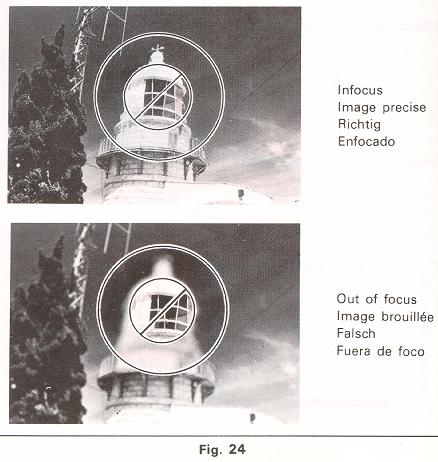
2.
Split-image Focusing is helpful for the subject with
either vertical or horizontal lines.
Rotate Focusing Ring (19) until the split image in
Split-image Spot (40) forms a single image. When it is out of focus, your I
subject is split into two parts (Fig. 24).
3.
Microprism Focusing is good for the subject which lacks
clear vertical or horizontal lines. Rotate Focusing Ring (19) until the image in
Microprism-image Band (39) appears sharp (Fig. 24).
4.
You can also focus with
any part of the area surrounding Microprism-image Band (39). This is most useful
when taking pictures with ultra telephoto lenses or in close-up photography with
bellows unit, macro lenses or extension rings because the other focusing aids
may darken appreciably.
UNLOADING FILM
After the last picture on the roll of film has been taken.
rewind the film and unload your camera.
1.
Press Film
Rewind Release Button (33) (Fig. 25).
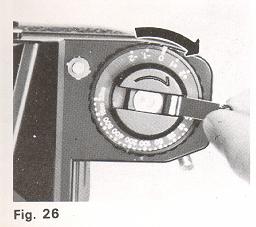
2.
Lift up Film Rewind Crank (2) and turn it clockwise
until Film Rewind Release Button (33) stops revolving and you feel the film
tension released (Fig. 26) This indicates that the film has been completely
rewound into the cartridge.
3. Open Back Cover (37) by
pulling up Film Rewind Knob (1).
4.
Remove the film cartridge
and have the film processed as soon as possible.
Tips for Better Results
*
Always unload your camera in the shade or in a poorly
lit place, never in direct sunlight
or other bright light.
*
When you reach the end of the roll film. Film Advance
Lever (13) will tighten and refuse
to advance. If this happens, do not
advance Film Advance Lever (13) by force for
"just one more shot", otherwise the
film will be torn out of the cartridge.
*
Film Rewind Release Button (33) will remain in place once
it is pressed, and return
automatically to its original position
when Film Advance Lever (13) is advanced.
TAKING FLASH PICTURES
You can use a flash at night or in a dimly lit room as
well as for supplementary lighting in outdoor photography The camera and
electronic flash will be fully synchronized with the shutter speed at "B''. "X''
and 4 sec. to 1/125 sec. Since proper flash exposure may not be obtained by
automatic exposure setting, always override Shutter Speed Dial (8) from "AUTO"
setting.
The RICOH XR Speedlite 240 is available exclusively for
use with the RICOH KR- 10.
How to Use the RICOH XR Speedlite 240
1.
Attach XR Speedlite 240 to the KR-10.
2.
Turn on the power source switch on the flash unit.
3.
When the flash unit is fully charged. the FLASH LED (25)
on the frame of the
view-finder eye-piece will turn red
indicating it is ready for use.
4.
When the shutter speed on the camera is set to "AUTO'',
it is automatically
synchronized at 1/90 sec. This avoids
the trouble of having to set the correct speed yourself.
5.
With ASA 100 film, the F-stop should be set at 5.6. and
the flash unit will
automatically control the amount of
light to give the correct exposure.
Tips For Better Results
*
Do not use other makes of flash units that have a special
signal pin exclusively for their cameras. as this will result in incorrect
exposure or may even damage the circuitry
*
The XR Speedlite 240 has a range of synchronization of
''AUTO", "B". ''X". and from 4 sec. to 1/125 sec.
In Cases where You Do not Use the XR Speedlite 248
Use a flash unit with a built-in hot shoe contact only
because the camera is not equipped with flash terminal for a flash unit with
connecting cord
Exposure for Flash Photography
The exposure is determined by the guide number of the
electronic flash unit. The guide number represents a relationship between the
light output of the flash and the speed of the film. Guide numbers for
electronic flash units are found in the technical specifications. Using the
guide number, you can determine the correct f-stop for a given flash situation
using the following formula:
F-stop = Guide number - divided by - Flash-to-subject
distance
For example: If your flash unit has a guide number of 16
(m) or 52.8 (h ) for the type of film you are using, and your subject is 2
meters (6 6 h.) from the flash unit as indicated on Distance Scale (20) after
focusing, divide 16 (52.8) by 2 (6.6). The answer is 8; set F-Stop Ring (22) to
8 (f/8).
Tips for Better Results
*
If you are using an auto
electronic flash unit with power ratio control, follow the instruction
sheets packed with the flash unit.
*
Most electronic flash units have a built-in dial or
exposure table which enables you to
quickly compute f-stops based on
flash-to subject distances.
VIEWFINDER EYEPIECE CAP
When shooting with the self-timer or cable release where
you will not be viewing through Viewfinder Eyepiece (24) at the time the
exposure is made, viewfinder eyepiece cap should be used to prevent stray light
from entering through the eyepiece and affecting the automatic exposure system.
(Fig 27).
USING SELF-TIMER
Y
our KR-10 has a built-in
self-timer which delays the shutter release about maximum of 10 seconds. This
enables you to include yourself in your own picture and is also of benefit in
taking close-ups or photomicrographs where camera movement must be avoided.
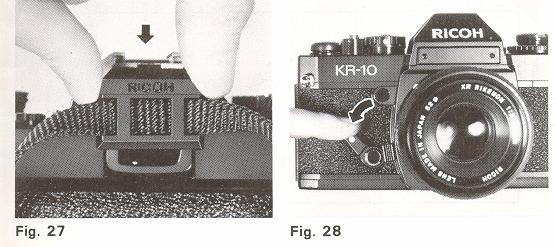
1.
First, advance Film Advance Lever (13)
2.
Merely move Self-timer Lever (16) counterclockwise (Fig 28)
According to the degree you have moved it down, you
can adjust the operating time. For the maximum delay. move it until it stops.
3.
Press Shutter Release Button ( 11 ) to start the
self-timer moving.
Tips for Better Results
*
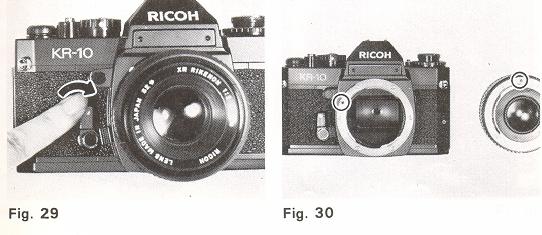
To clear the self-timer setting. turn the lever back to
its former position with your finger. (Fig 29)
*
You can set Self-timer Lever (16) firstly and then
advance Film Advance Lever ( 13)
*
The camera should be placed on a tripod or other firm support when using self-timer.
*
When using a tripod with a long thread length (more than 5.7 mm), be careful not to
forcibly screw in the thread further than the depth of the socket.
*
Shield the Viewfinder Eyepiece (24) by viewfinder eyepiece cap when using self-timer.
CHANGING LENSES
To mount the lens on the camera
1.
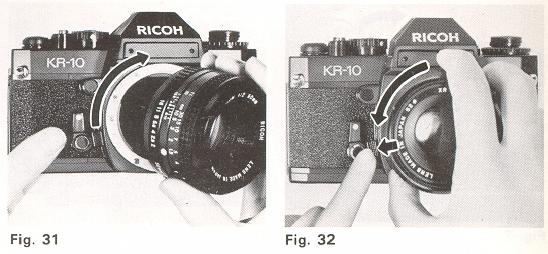
Mount the lens by lining up the red dot on the lens mount with the matching dot on the camera mount (Fig 30)
2.
Grasp the lens firmly around the lens barrel and turn it clockwise until it clicks into place (Fig. 31)
To remove the lens from the camera
1.
Grasp the lens firmly around the lens barrel in one hand.
2.
With the other hand, hold camera body and press Lens
Release Lever (17) and turn the lens counterclockwise until it stops (Fig. 32).
The lens now can be removed.
You can also change lenses without looking even in the
dark by means of Lens Locator Node (18). Line up Lens Locator Node (18) with
Lens Release Lever (17) and turn the lens clockwise for mounting the lens.
For removing the lens, press Lens Release Lever (17) and
turn the lens counterclockwise until Lens Locator Node (18) and Lens Release
Lever (17) line up.
Tips for Better Results
*
Whenever a lens is mounted on the camera. make sure that the lens is perfectly mounted. and clicks into position.
*
Do not touch any of the internal parts or permit dust or
dirt to enter the camera body when removing or attaching lenses.
*
Protect the inside of the camera by putting on the body cap whenever the camera is carried or kept with the lens removed.
DEPTH OF FIELD
When you focus on a specific subject. an area in front of
and behind the subject will appear acceptably sharp in your picture. This area
of acceptable sharpness is called "Depth of Field". The depth of field is
determined by the f-stop you select and the distance from the in focus subject
to the film plane' As you get closer to your subject. or as you open your lens
(for example. from f/16 to f/2 8), the depth of field becomes shallower.
By stopping the lens down (for example. from f/2.8 to f/16). the depth of field
becomes deeper. The depth of field can be pre-determined in the following ways:
Depth of Field Scale
After you have set the lens opening and have focused the
camera, the area of acceptable sharpness in front of and behind your subject can
be also determined on Depth of Field Scale (21).
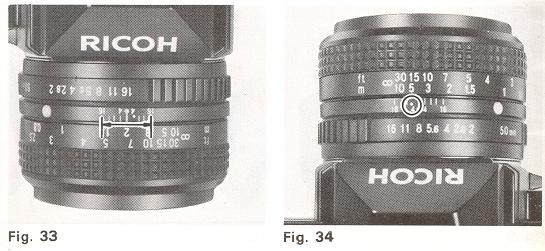
Locate on Depth of Field Scale (21) the two numbers
corresponding to the f-stop you have set on F-Stop Ring (22). The distance
between these two F-stops on Distance Scale(20)will be an area of acceptable
sharpness in your picture For example. if your lens is focused at 2 meters (6 7
ft.) and you shoot at 16 (f/16), the area of acceptable sharpness will be from 1
5 m (5 ft.) to 3.2 m (10.7 ft.). by reading Distance Scale (20) opposite the
both sides of the "16'' numbers on Depth of Field Scale (21) (Fig. 33).
INFRARED PHOTOGRAPHY
(Web Master: These instruction are for Black and White Infrared film only.
If you want, there are many IR digital cameras)
For infrared photography using infrared films, a
correction of Distance Scale (20) is necessary because ''infrared light rays''
focus on a film plane slightly behind that of ''visible light rays''.
1.
Normally focus on your subject and note the
camera-to-subject distance. Opposite the distance index line on Distance Scale (20)
2.
Turn Focusing Ring (19) until this camera-to-subject distance setting is opposite the infrared index line.
For example, if Distance Scale (20) reads 5 m (16.5 ft.)
after focusing, merely shift the ''5'' scale to the ''a" (red) position (Fig 34)
Tips for Better Results
*
Infrared radiation varies with the degree of infrared light rays in the atmosphere
*
For exposure. follow the instruction sheets which are packed with the film. and expose manually because metering with the built-in
exposure meter is not possible.
INTERCHANGEABLE LENSES AND ACCESSORIES
A wide range of XR RIKENON interchangeable lenses
including extremely wide angle lenses, telephoto lenses, zoom lenses and various
accessories are available to enable you to expand the pleasure of your
picture-taking. XR RIKENON interchangeable lenses and accessories are made of
selected high quality materials under strict quality control to assure you of
high performance and full satisfaction. Select XR RIKENON interchangeable lenses
and accessories that will meet your needs.
Since the camera is designed to accept any lens with the
"K" type bayonet mount, your KR-10 affords you the opportunity to select
any interchangeable lens or accessory of the "K" type bayonet mount available on
the market.
RICOH XR WINDER-1:
The RICOH XR WINDER-1 can be used with the KR-10. By
operating the shutter release button on the winder, it can be used for rapid
sequence photography at approximate 2 frames per second (at shutter speed
of 1/125 sec.) By just setting the selection switch you may choose
frame-by-frame shots or rapid sequence shots according to your needs. You
can for instance capture the rapid movement in sports, or the fleeting facial
expressions that make your picture-taking a more enjoyable experience.
PROPER CARE OF YOUR CAMERA
*
Always carry your camera
with its carrying case tend neck strap.
*
Use the lens cap to protect the lens when not taking pictures.
*
Protect your camera from dust. dirt, water, rain, dampness, salt air and rough handling.
*
Never expose your camera to excessively high or low temperatures for an extended period of time. In extremely hot climates, do not
leave your camera inside closed automobiles during the daytime or in direct sunlight. In extremely cold climates expose your camera to the outer
air only when in use.
When using. . . . . expose your camera gradually to the outer air to prevent the lens from clouding. If exposed to an
extremely cold climate, the exposure meter batteries may fail to operate properly. Keep your camera inside your clothing until taking a picture.
*
Never touch the surfaces of the lens, metal focal plane shutter curtain, reflex mirror, etc. with your fingers.
*
To clean the lens, gently wipe it in a circular motion with a lens cleaning paper or a soft,
clean and lintless cloth. (Web Master:
do not use eyeglass wipes, they can scratch according to the experts)
*
Do not wipe the camera body with chemicals. such as
benzene, thinner. etc.. use only soft cloth or cotton swab sprinkled LIGHTLY with alcohol on the camera body. Do not use them on the lens because it can
affect coating.
*
When your camera is not in
use for an extended period of time, put on the lens cap, remove the batteries, place your camera in its carrying case together with silica gel or other
desiccant and store it in a dry and cool place.
*
Never store your camera in places where the temperatures are excessively high or low.
*
Do not attempt to disassemble or repair your camera
yourself. If service is necessary, get in touch with your dealer or authorized Ricoh service station.
*
Do not leave your camera near the magnetic objects like radio. television set etc.
MAJOR SPECIFICATIONS OF KR-10
Camera Type: 35 mm
aperture-priority AE (automatic exposure) SLR with electronic metal focal plane shutter
Film Size and Capacity:
35 mm perforated film in 12, 20, 24 or 36 exposures
Film Format: 24 x 36 mm
Standard Lens:
50 mm XR Rikenon f/1.4 (multi-coated), 6 groups 7 elements
50 mm XR Rikenon f/1.7 multi-coated). 5 groups 6 elements
50 mm XR Rikenon f/2.0, 5 groups 6 elements
Filter size: 52 mm
screw-in type
Lens Mount: "K" type bayonet with 65° rotating angle
Shutter:
Vertically moving Copal CCS-E electronically controlled metal focal plane shutter
Automatic electronic shutter: continuously
variable speeds from LT (approx. 8 sec.) to 1/1000 sec.
Manual electronic shutter:
stepped speed from 4 to 1/1000 sec.
Manual mechanical shutter
without batteries: ''B'' and "X" (1/90 sec.)
Viewfinder: Fixed
eye-level pentaprism
Shutter speeds: "A" (automatic). "B" (bulb).
"X" (1/90 sec.). Exposure meter needle, Shutter speed indicator
Viewing
magnification: 0.83X
Field of
view: covers 93% of actual picture area
Flash ready
lamp (LED)
Focusing: Diagonal
split image spot in microprism band surrounded by Fresnel field
Exposure Meter:
Three CdS photocells TTL full open metering for center-weighted average
light reading coupled to aperture-priority automatic exposure system
Exposure Coupling Range:
EV3 - 17 (ASA 100 film with 50 mm f/1.4 lens)
Film Speed Range:
ASA 12 ~ 3200 (DIN 12 ~ 36)
Exposure Meter Power Supply:
Alkaline Battery (LR-44) duration about half a year
Silver-Oxide Battery (G13. MS76, S76) duration about a year
Mercury Battery (H-C. EPX675. PX675) duration about half a year
Flash Synchronization:
X synchronization for electronic flash unit at "B'',
''X" (1/90 sec.)
and 4 sec. to 1/125 sec.
Automatic Flash Control:
With Ricoh XR Speedlite 240, set shutter speed dial at
Auto
and it will set shutter speed 1/90 sec automatically.
Manually set the aperture ring to the same aperture set on flash.
Film Loading:
Multi-slit easy loading
Film Wind:
Single stroke film advance lever with 135° winding angle (40° play)
Automatic winding possible by mounting Ricoh XR Winder-1.
Film Rewind:
Film rewind crank by pressing film rewind button on
base of camera
Exposure Counter:
Additive, automatic resetting
Other Features:
Plus/minus 2 - stop exposure compensation dial ( + 2, + 1 - 1 - 2)
ASA/DIN
conversion label (on back of back cover)
Automatic
exposure lock button,
Self-timer,
Hot shoe,
Shutter
release lock With film advance lever)
Meter
on/off switch (with shutter release button)
ASA dial
lock
Cable
release socket
Tripod
socket
Dimensions: 140
(width) x 91 (height) x 50 (depth) mm (body only) Weight: 545 9 (body only)
Specifications are subject to change without
notice.