and historical purposes, all rights reserved.
This page is copyright© by
 ,
M. Butkus, NJ.
,
M. Butkus, NJ.This page may not be sold or distributed without
the expressed permission of the producer.
I have no connection with any camera company.
This camera manual library is for reference
and historical
purposes, all rights reserved.
This page is copyright©
by
,
M. Butkus, NJ.
This page may not be sold or distributed without
the expressed
permission of the producer.
I have no connection with any camera company.
On-line camera manual library
If you find this manual useful,
how about a donation
of $3 to:
M. Butkus, 29 Lake Ave.,
High Bridge, NJ 08829-1701
and send your e-mail
address
so I can thank you.
Most other places would charge
you
$7.50 for a electronic copy
or $18.00 for a hard to read Xerox copy.
Back to main camera manual page
Click here to see Praktica MTL 3
manual from HTML in PDF format
Praktica MTL3 PDF - Direct
from manual
Praktica MTL3 Bedienungsanleitung
Praktica MTL3 Mode D'Emploi
Praktica MTL3 Gebruiksaanwijzing
AKA: Revueflex TL 1
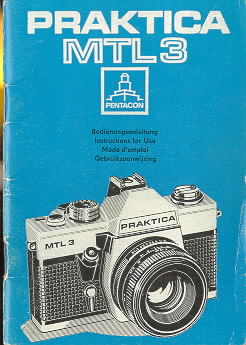
We wish you all success with this modern reflex camera. You own a camera with
the novel metal-blade focal-plane shutter for maximum shutter speed stability and
minimum synchronization for electronic flash photography. The camera is fitted with
a through the-lens light metering system for a coupled determination of shutter
speed, diaphragm numeral, and film speed. Metering is on the center-weighted method
and gives pictures true to the subject.
Before you start snapping away happily
will you please read these Instructions for Use carefully. You will avoid trouble
with the camera and disappointments with the pictures.
Control Parts of the PRAKTICA MTL 3
|
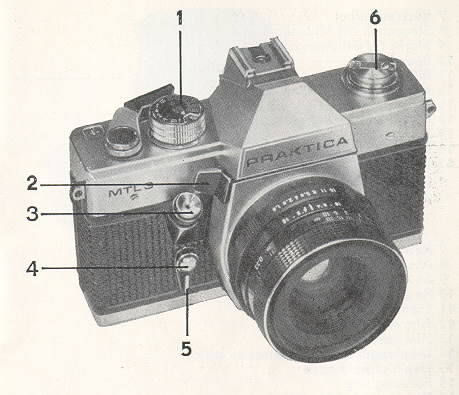
1. Shutter speed setting knob 2. Metering key 3. Shutter release with cable release 4. Self-timer release knob 5. Self-timer winding lever 6. Rewind button 7. Rewind release 8. Accessory shoe with center contact
|
 |
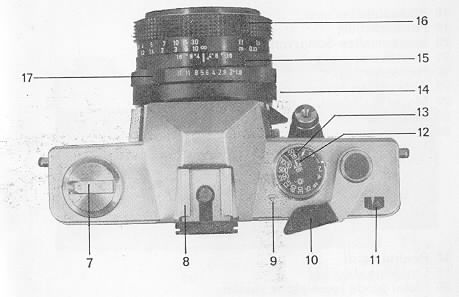 |
9. Shutter speed mark 10. Rapid wind lever 11. Exposure counter 12. Film speed mark 13. Film speed dials 14. Diaphragm operation selection switch 15. Depth-of-field scale 16. Focusing ring 17. Diaphragm setting ring |
|
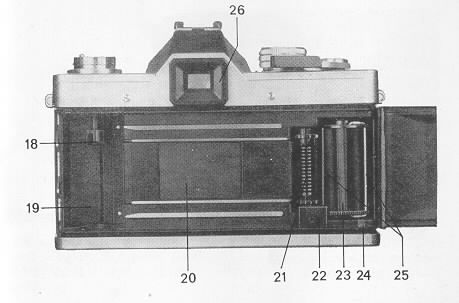
18. Rewind catch 19. Cartridge chamber 20. Metal-blade focal-plane shutter 21. Film sprocket 22. Support 23. Take-up spool 24. Film loading mark 25. Wire brackets |
 |
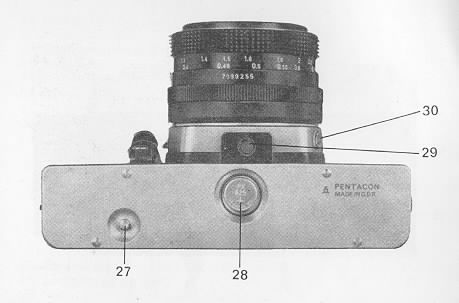 |
26. Eyepiece mount with accessory adapter 28. Battery compartment with battery 29. Tripod thread 30. Flash socket |
In the following instructions the numbers of the above elements are put in
parentheses ( ).
 |
 |
|
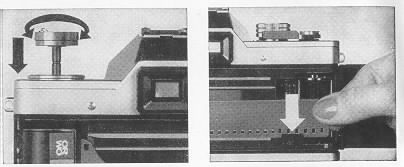
Opening the camera back |
|
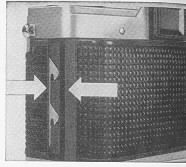
| Closing the back.
The back locks automatically when you press it to the camera body. at the latch side. |
 |
 |
Setting and winding
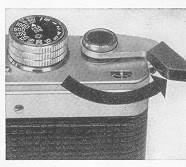
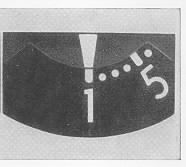
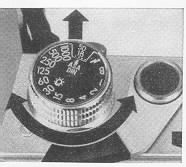
the shutter Rapid wind lever (10) has a dead stroke of about 15 deg. till the mechanism engages. This makes for safety at series exposures. Swivel lever (10) to its stop, move it bock and depress shutter release (3). Repeat the process and finish up by winding the camera again. The automatic exposure counter (11) will now read exposure 1. |
 |
Film speed setting |
Shutter speed setting
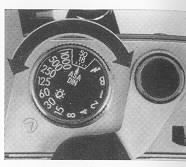
| Symbol f | for electronic flash photography (about 1/125sec) |
| Setting B | for time exposures; the shutter remains open as long as the shutter release is depressed |
| 1 sec. to 1/15 sec. | (orange) for low light photography; a tripod is needed |
| 1/30 to 1/1000 | (white) for satisfactory light photography |
Rotate shutter speed dial (1) till the desired speed matches the orange triangle.
Diaphragm setting
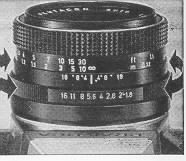 |
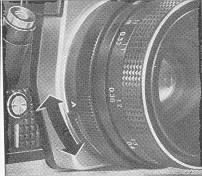
Set the desired diaphragm number on diaphragm setting ring (17) of the lens opposite to the mark on the lens mount. When lenses with automatic pressure diaphragm (ADB)-are used, the diaphragm remains fully open and closes to the set value only when the shutter release is pressed. The diaphragm opens in the same instant the shutter has run down. By changing the diaphragm operation selection switch (14) from A (automatic operation) to M (manual operation) or by actuating the metering key (2) it becomes possible to check the depth of field already on the viewfinder image. |
 |
Automatic exposure control system
There are two modes of light metering:
1. Metering by altering the diaphragm
numeral at the lens with pre-selected shutter speed (being the preferred method
for general objects in satisfactory light).
2. Metering by altering the shutter
speed with pre-selected diaphragm numeral (being recommended for low light photography
with a certain depth of field required).
Metering at pre-selected shutter speed
Set the shutter speed, press metering key (2). Turn diaphragm setting ring (17)
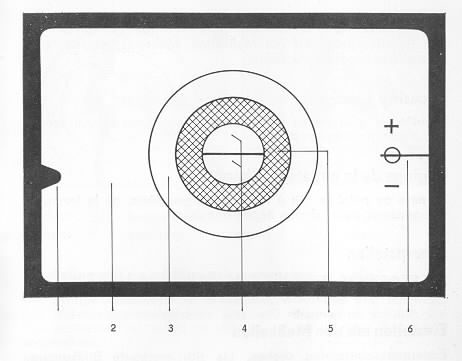
until the meter needle, visible in the viewfinder, will have centered to the circular
mark. When the needle stands in the + range, an overexposure will be obtained while
its position in the --range will result in an underexposure. The diaphragm opens
and closes on rotating the diaphragm setting ring correspondingly thus compensation
between subject brightness and the combined shutter speed, diaphragm, and ASA/DIN
settings is performed.
Metering at pre-selected
diaphragm number
Set the diaphragm numeral,
press metering key (2). Turn shutter speed dial (1) until the meter needle visible
in the viewfinder will have centered to the circular mark. When the needle stands
in the + range, an overexposure will be obtained while its position in the--range
will result in an underexposure. Don't set any intermediate shutter speeds between
the indexed positions. Should you not succeed in attaining a perfect balance, you
can make a precise correction by the diaphragm setting ring which may, of course,
be set to intermediate values, too.
Metering with lenses without automatic diaphragm system
How to control:
Set the diaphragm to its smallest diaphragm number - focus the
lens--balance the system by stopping down.
Functional range of
the automatic exposure control system
Outside of the range of the Table below the metering system is switched off.
The meter needle is in rest position below the circular mark in the minus range.
Metering cannot be made with the "B" or symbol f .
| ASA | min. and max speeds | ASA | min. and max times | |
| 12 to 16 | 1 to 1 1/25 | 200 - 330 | 1/4 to 1/1000 | |
| 20 - 32 | 1 to 1/250 | 400 to 660 | 1/8 to 1/1000 | |
| 40 - 65 | 1 to 1/500 | 800 to 1300 | 1/15 to 1/000 | |
| 80 | 1 to 1/1000 | 1600 | 1/30 to 1/1000 | |
| 100 - 165 | 1/2 to 1/1000 |
|
1. Signal 2. Image brightening Fresnel lens 3. Circular ground glass area
|
4. Pair of metering wedges
5. Microprism screen 6. Meter needle with circular mark |
Focusing
Focusing is possible as
to metering wedges, microprism screen, or circular ground glass area.
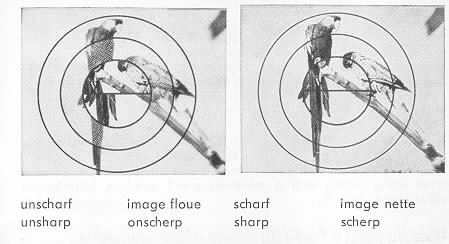 |
Focusing on the measuring wedges
Turn the distance setting ring until defined outlines of the picture parts will stand opposite to one another. |
Focusing on the microprism screen
Maximum sharpness is attained
when the image in the microprism screen is clear and does not flicker. Don't use
the ground glass Fresnel for focusing.
Depth-of-field
scale
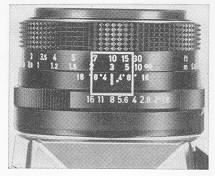 |
The depth of field attained with a certain diaphragm setting can be read on scale (15). Example: Distance 3 meter, diaphragm numeral 8, depth of field extends from 2 metes to 5 meters. For checking the depth of field on the viewfinder image, too, depress metering key (2), set selection switch (14) to M and the switching lever (of PANCOLAR 50 mm fl1.8) to its lower position, resp, Infrared photos require a slight correction in focusing; let the determined distance meet the infrared mark on the lens. |
Releasing and winding
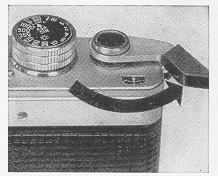 |
Please note before pressing the shutter release: |
Self-timer
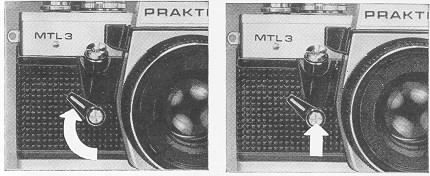 |
Wind the shutter. Turn lever (5) upwards to its stop. Press release (4)--the self-timer will now run for about 8 seconds. Do not wind the shutter while the self-timer runs. |
Film changing
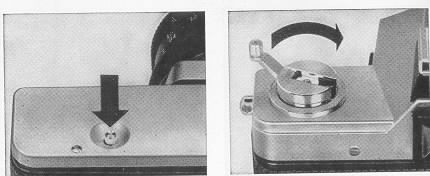 |
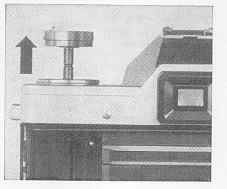
Observe the exposure counter for the number of pictures you can take with the film in your camera (12, 20 or 36 exposures). After the last exposure press rewind release (27) (it locks). Tilt the folding rewind crank (7) out of rewind button (6) and turn it not too fast in the direction of the arrow (indicated on crank (7). You will feel the end of rewinding by a somewhat increased resistance with subsequent easy running. Pull the rewind button up to the stop, the camera back being thus released, and take the cartridge out. |
Note. Should you have exposed a few more frames than specified on your film packing
it might be possible that the rapid wind lever can only be turned partially. Do
not use force in this case but rewind the film.
Lens changing
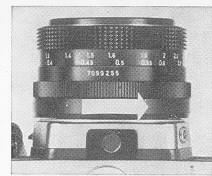 |
Any lenses having the international M 42 x 1 PRAKTICA thread can be applied. Grip the lens body and unscrew it in counterclockwise direction; screw in the other lens in clockwise direction to the stop. |
Flash photography
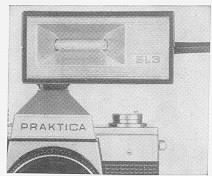 |
This camera has been designed for synchronization of flash bulbs and
electronic flash units. Flash units provided with a center contact are pushed
into accessory shoe (8). Connect flash units fitted with synchro cable and
flash contact with flash socket (30). Set the symbol ( f or 0) of
the relevant type of flash unit on the shutter speed dial. The firing circuit
is only closed as long as the shutter is running down. |
The use of flash bulbs
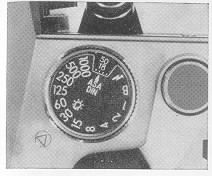 |
For fast burning flash bulbs the speed dial is set to the symbol or 0 to a shutter speed longer than 1/30 sec. |
The use of electronic flash units
|
|
These will be synchronized at setting to the symbol t which corresponds to a shutter speed of about1/125 sec. Longer shutter speeds can be set. |
Battery replacement - (my
site has information on mercury battery replacements)
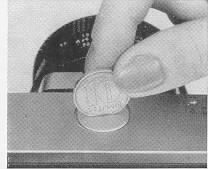 |
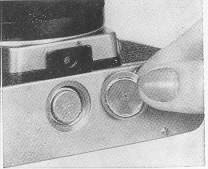
The automatic exposure control system is powered by a PX 625 mercury
oxide element or a corresponding type of 1.35 Volt rated voltage. |
Care of the camera
Operation according to instructions and
proper care are essential preconditions for trouble free function of this high-precision
instrument. Protect it from shocks, blows, dust, and moisture, clean cartridge and
spool compartments, film track and camera back with a soft brush in suitable intervals.
Do not exert any pressure onto the shutter blades and do not touch them with your
fingers. Dust the mirror with a soft brush only if absolutely necessary. Don't clean
the camera with organic solvents, such as spirit, varnish thinner or the like. The
camera will work unobjectionably within the temperature range of +40 °C to -10 °C.
Above and below this range for some reasons the mechanical and electrical and electronically
functions may fail. If the camera e.g. undergoes sudden changes in temperature,
condensate will form which will cause damages by corrosion.
Special attention
should be paid to the battery and its contact points. Check them in short intervals
and clean, if necessary. Since the battery is susceptible to low temperatures, protect
it against cold and remove it from the camera when not being used for some time.
The PRAKTICA MTL 3 is selectively delivered with or without self-timer.
Please observe the recommendations contained in this booklet and remember, as
far as reading is concerned, that repetition is the mother of wisdom. Handling the
camera carelessly or contrary to instructions may lead to damages which, we regret
to say, are not covered by our guarantee.
Our consistent efforts to improve
our products may lead to some slight deviations of the PRAKTICA MTL 3 from the present
details.