and historical purposes, all rights reserved.
This page is copyright© by
 ,
M. Butkus, NJ.
,
M. Butkus, NJ.This page may not be sold or distributed without
the expressed permission of the producer.
I have no connection with any camera company.
This camera manual library is for reference
and historical
purposes, all rights reserved.
This page is copyright©
by
,
M. Butkus, NJ.
This page may not be sold or distributed without
the expressed
permission of the producer.
I have no connection with any camera company.
On-line camera manual library If you find this manual useful, Back
to main camera manual page
CLICK HERE FOR Petri FT EE PDF
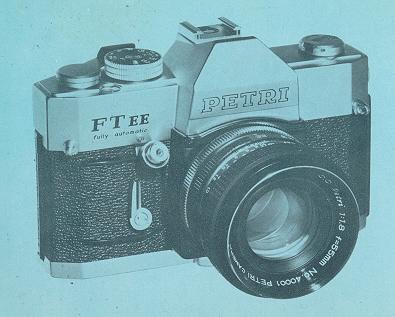
TYPE: Automatic EE camera with Pentaprism viewfinder and built-in cross coupled
CdS exposure meter in open aperture Through-The-Lens metering system. Fl LM: 35mm film (20, 36 or 12 exposures) PICTURE: 24mm x 36mm EXPOSURE SYSTEM: Shutter speed pre-selected system.
CdS exposure meter automatically measures optimum exposure conditions ranging
from EV 3 to EV 17 with ASA 100 (DIN 21) film. Geared to the use of the
normal lenses. Manual operation possible. ASA: 25 to 800 DIN: 15 to 30
how about a donation
of $3 to:
M. Butkus, 29 Lake Ave.,
High Bridge, NJ 08829-1701
and send your e-mail
address
so I can thank you.
Most other places would charge
you
$7.50 for a electronic copy
or $18.00 for a hard to read Xerox copy.
This will help me to continue to host this site,
buy new manuals, and pay
their shipping costs.
It'll make you feel better, won't it ?
If you use Pay Pal, use the link below.
Use the above address for a
check, M.O. or cash.
MADE DIRECTLY FROM
HTML file below
LENS: Petri 55mm f/1.8, 6 elements in 4 groups,
combination coated, with fully automatic diaphragm, aperture stops down to f/16.
SHUTTER: Focal plane
type with speeds of 1/2, 1/4, 1/8, 1/15, 1/30, 1/60, 1/125,1/250 and 1/500
second and B. Built-in self-timer.
VIEWFINDER: Pentaprism viewfinder with Micromatic prism focusing device. The exposure meter needle and diaphragm number visible in the viewfinder. Under/Over exposure warning marks also visible.
Fl LM TRANSPORT: Single stroke rapid film winding and shutter winding
LENS MOUNT: Petri bayonet lens mount
SYNCHRONIZATION: FP and X automatic setting
FILTER SIZE: 52mm screw-in type
LENS HOOD SIZE: 54mm slip-on type
DIMENSIONS: 5.5 x 3.5 x 3.4 inches (142 x 93 x 88mm)
WEIGHT: 32 oz. (910 9.)
NOTE: 35mm and 135mm lenses, exclusively designed for the EE
system, available.
INDEX
| MAJOR SPECIFICATION OF PETRI FT EE . . 2 INDEX . . . . . . 3 DESCRIPTION OF PARTS . . . . . . . 4 BATTERY FOR THE CdS EXPOSURE METER . . . . . 7 FILM WlND LEVER . . . . . 8 EXPOSURE COUNTER . . . . .8 FILM SPEED (ASA OR DIN) SETTING . . . . . . 9 SHUTTER SPEED DIAL .. . . . . . . . 10 EXPOSURE WARNING MARKS . . . . . 13 TO CHECK THE DEPTH OF FIELD . . . . . 16 TO TAKE CLOSE-UPS . . . . . 16 TO USE NORMAL LENSES . . . . .16 |
EXPOSURE METER COUPLED RANGE . . . . .17 SHOOTING AGAINST THE LIGHT . . . . . 18 VIEWFINDER AND FOCUSING . . . . . . 19 DEPTH OF FIELD . . . . . . 20 HOW TO READ THE DEPTH OF FIELD SCALE . . . . . . 20 HOW TO HOLD YOUR PETRI FT EE CAMERA . . . . . . .22 Fl LM LOADING . . . . . . .23 FILM UNLOADING . . . . . 25 HOW TO CHANGE YOUR LENS . . . . . . . . 26 F LASH PHOTOGRAPHY . . . . . . . . . 27 HOW TO USE BUILT-IN SELF-TIMER . . . . . . 29 INFRA-R ED PHOTOGRAPHY . . . . . . . 29 MAINTENANCE AND CARE OF YOUR PETRI FT EE . . . . . . 30 PETRI INTERCHANGEABLE LENSES . . . . . . . . 31 |
DESCRIPTION OF PARTS
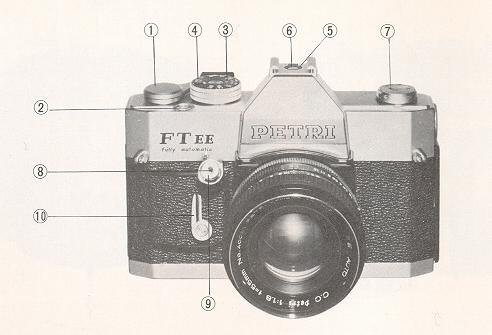 |
(1) Film Advance Lever (2) Film Counter (3) Shutter Speed Dial (4) Film Speed Indicator (5) Accessory Shoe (6) Cordless Flash Contact (7) Film Rewind Crank (8) Cable Release Socket (9) Shutter Release Button (10) Self-timer Lever |
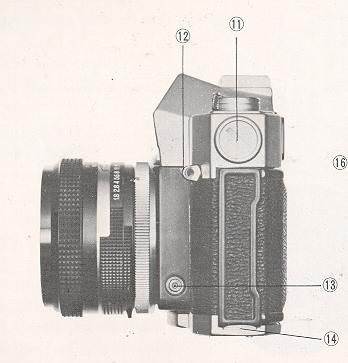 |
(11) Battery Compartment (12) Neck Strap Loop (13) Flash Socket (14) Back Cover Lock
|
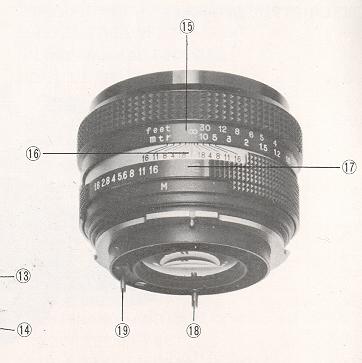 |
(15) Distance Scale (16) Depth of Field Indicator (17) Diaphragm Scale (18) Diaphragm Pin (19) Aperture Control Pi n
|
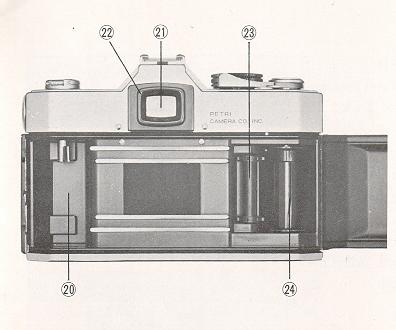 |
(20) Film Cassette Chamber (21) Viewfinder (22) Viewfinder Frame (23) Sprocket (24) Take-up Spool
|
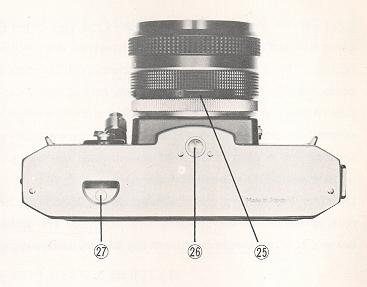 |
(25) Auto and Manual Diaphragm Lever (26) Tripod Bush (27) Film Rewind Button
|
BATTERY FOR THE CdS EXPOSURE METER
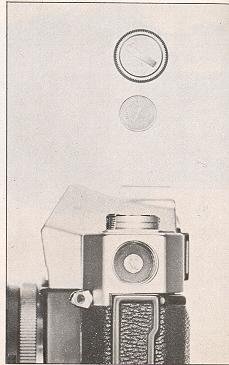 |
The built-in CdS exposure meter is powered
with a 1.3 volt mercury battery
(Mallory RM 675R, National M-1C, Toshiba TM-KC or equivalent). The battery
compartment is located on the left-hand side of the top cover. The exposure
meter is switched on by a stroke of the film advance lever. When the exposure
meter needle does not respond to a change of light conditions, the battery
has become exhausted and must be replaced. Unscrew the battery compartment cover with your finger tips or a coin and insert a new battery with the plus (+) upward, facing battery compartment cover, into the battery compartment. (Mercury batteries are no longer available. Use Wein Air batteries or adapters that change standard button batteries to 1.3v. |
FILM WIND LEVER
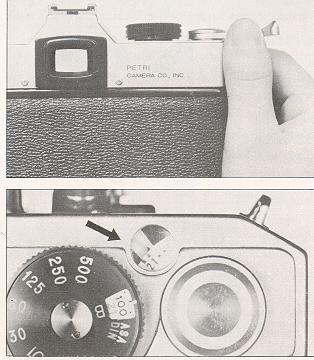 |
When the film wind lever is advanced, the following things happen simultaneously: 1. The battery switch is turned on and the exposure meter is activated. 2. The film frame is transported to the next unexposed frame. 3. The film counter is advanced. 4. The shutter is wound. After the shutter is released, the battery circuit is shut off and unnecessary battery drain is avoided.
|
EXPOSURE COUNTER
The counter is located on top of
the camera body. It shows the number of film frames exposed, and automatically resets
to ''S" (for "Start") position when the back cover is opened. Frames of the 20th
and 36th are marked in red to signal end of the roll, depending on the length of
the film used.
FILM SPEED (ASA OR DIN) SETTING
 |
After the film has been loaded, be sure
to set the ADA or DIN film speed index specified for the film in use on
the film speed scale. This adjusts the exposure meter for the film being
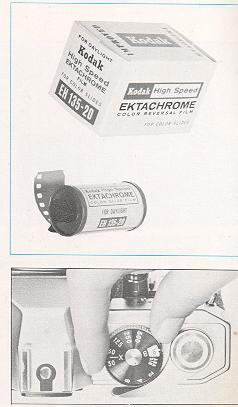
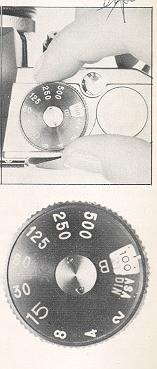
used and an essential step in getting properly exposed pictures. To set the film speed, raise the external ring of shutter speed dial and turn to align the reading equivalent to speed of the film in use with the index mark. Do not set in between click-stops. If the reading does not align correctly, the ring will never drop down. The black numbers represent ADA values and range from ADA 25 to 800, and the red numbers represent DIN values ranging from DIN 15 to 30. Read the instructions supplied with the film and set the correct film speed index number. If the number of the film speed corresponding to that of your film is not available on the film speed scale, use the closest number and never set between two settings. For convenience, the positions for intermediate film speeds are shown only by dots. See the illustration. |
SHUTTER SPEED DIAL
 |
Your camera shutter has a range
of speeds covering sufficiently all the ordinary picture situations. It
has the settings of: 1/500, 1/250, 1/125, 1/60, 1/30, 1/15, 1/8, 1/4 and
1/2 second and Bulb. When the Bulb setting is used, the shutter stays open
as long as the shutter button is being depressed ( f or time exposure).
The settings are represented on the shutter speed dial located right-hand on top of the camera body. For convenience, only the lower half of the numbers (250 for 1/250, etc.) and B (for Bulb) are etched on the black wheel. The shutter speed is set by lining up the appropriate number or B with the black line on the Pentaprism cover. Do not set the shutter speed between two click-stops. The shutter speed can be selected either before or after the shutter has been wound. For indoor photography, it is recommended to set the shutter at 1/30 or 1/60; for outdoor photography, at 1/125 or 1/250; and for action photography such as in sports or snap shots it is important to use faster speeds of 1/250 or 1/500 to avoid blurring. The number "15" for 1/15 second is larger than others and painted in fluorescent. When using the shutter speeds slower than 1/15 second, it is recommended to use a tripod and a cable release equipment so as to avoid camera shake. |
DIAPHRAGM SCALE (APERTURE SETTING)
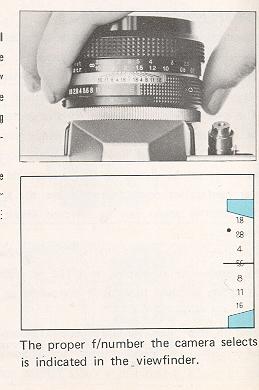 |
The diaphragm scale is located on upper side of the lens barrel and there
is an "EE" mark in red letter on it. When the diaphragm is set at the "EE"
mark, the camera automatically selects the optimum aperture opening corresponding
to the amount of light entering the lens. The proper aperture opening the
camera has selected is indicated by the needle in the viewfinder. The aperture opening has seven settings, ranging from f/1.8, the maximum opening, to f/16, the minimum opening. For further information as to the diaphragm scale, see MANUAL EXPOSURE CONTROL IN THROUGH-THE-LENS SYSTEM (page 15).
|
FULLY AUTOMATIC EXPOSURE CONTROL IN THROUGH-THE-LENS SYSTEM
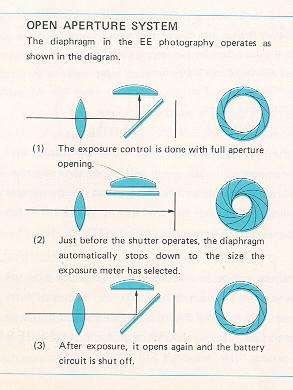 |
Set the aperture at "EE" mark in red letter on the diaphragm scale. This
is all you have to do for exposure control. By setting the aperture at the
"EE" mark, the auto and manual diaphragm lever is automatically switched
to the "A" position (fully automatic operation) even in case it is being
set at the "M" position in green (manual operation). Thus, the exposure
control is done with the full aperture opening and the viewfinder is always
seen bright for easy and accurate focusing. (This is called "Open Aperture
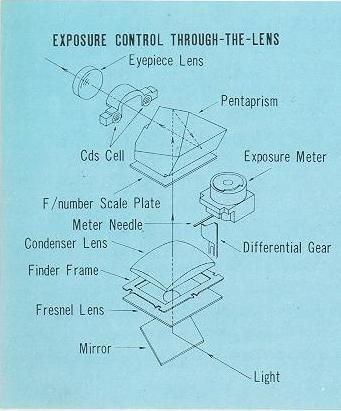
System. ) The light entering Through-The-Lens strikes the two CdS cells located on each side at the base of the Pentaprism (see the diagram) and the CdS cells measure the average brightness of subjects you frame in the viewfinder. (This is what is called "Through-The-Lens metering system".)
|
 |
The B (bulb) setting is not usable in
the Electric Eye photography. Switch the diaphragm to the manual operation
and set the diaphragm by turning the diaphragm scale. The stopped-down
light measuring is applicable to the 55mm 1J, standard Electric
Eye lens, but not to other interchangeable Electric Eye lenses.
EXPOSURE WARNING MARKS In the viewfinder there is a diaphragm scale and on each end of the scale you will notice the red zone. The red mark above the f/16 is an over-exposure warning mark, and the one below the f/1.8 is an under-exposure warning mark.
|
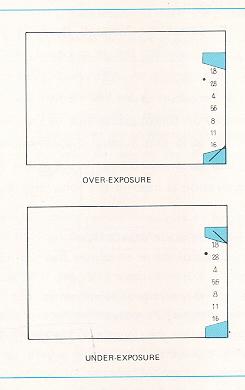 |
(1) OVER-EXPOSURE (2) UNDER-EXPOSURE When the exposure meter needle jumps up to the under-exposure warning mark, it shows "underexposure". Set the shutter at a slower speed. However, at the slower shutter speed than 1/15 second, it is recommended to use a tripod to avoid camera shake. When the meter needle won't come down to the diaphragm scale in the viewfinder, it shows that the amount of light entering the lens is extremely poor for the normal photography. Use flood illumination or switch to the flash photography (see FLASH PHOTOGRAPHY at page27). |
IMPORTANT
Make sure that the film speed is set at the correct
reading specified for the film in use. (For further information, see FILM SPEED
SETTING at page 9 .) The automatic exposure control is not applied to the flash
photography.
MANUAL EXPOSURE CONTROL IN THROUGH THE-LENS SYSTEM
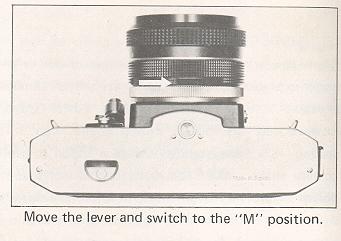 |
There is a "M" (short for Manual) mark in green letter around the upper side of the lens barrel, and the auto and manual diaphragm lever (do) which switches the diaphragm to "M" position from "A" (short for Automatic) position is located on the opposite side of the "M" and "A" marks. Move the auto and manual diaphragm lever to the left, and you will see the diaphragm is set at the "M" position. The manual operation is used in the following photographic situations: |
TO ADJUST THE EXPOSURE CONDITION
When the main subject
of the whole picture area you frame in the viewfinder is extremely dark or bright,
it is recommended to adjust the exposure condition so that the important subject
is correctly exposed. Set the exposure at the "EE" control and read the F number
in the viewfinder. Then, swing the auto and manual diaphragm lever to the left and
set the diaphragm on the "M" position. If the important subject is comparatively
dark, set the f/number at a half or one stop closer to the full aperture than the
f/number indicated in the viewfinder when you have set the exposure at the "EE"
control. If the subject is brighter, set the f/number at a half or one stop closer
to the minimum aperture than the f/number the "EE" control let you know. For example,
when you take a portrait with a back-ground of snow scene or on the beach, you can
get a properly exposed picture by using a half or one stop wider aperture opening
than normal.
TO CHECK THE DEPTH OF FIELD
Setting
the auto and manual diaphragm lever on the "M" position you can pre-view the depth
of field and see in the viewfinder the lens zone of sharpness with any aperture.
TO TAKE CLOSE-UPS
When you use a close-up unit such as the extension, tubes or the extension bellows, the automatic exposure control does not work. PETRI FT EE, however, has a means of obtaining a proper exposure setting.
Look through the viewfinder, and you will see a small blue dot very close to the f/2.8 in the diaphragm scale. This is the exposure indication mark.
First, set the diaphragm on the "M" position and select an appropriate shutter
speed.
Then, looking through the viewfinder swing the diaphragm ring as
far as the meter needle comes on to the exposure indication mark in the diaphragm
scale. Through these procedures you can get the optimum exposure setting. If the
meter needle stays above the mark, use a slower shutter speed, and if it stays under
the mark, use a faster speed.
NOTE: In manual exposure control, the diaphragm
ring should be swung between f/1.8, the largest aperture, and f/16, the smallest
aperture. If you have inadvertently swung it to the "EE" mark on the diaphragm scale,
the diaphragm is consequently switched to the position in the automatic exposure
control. So, switch the diaphragm to the "M" position again.
TO
USE NORMAL LENS
When you use the normal lenses that are not designed for the "EE" photography,
the automatic exposure control does not work. However, you can obtain the proper
exposure reading 'through the procedures stated in TO TAKE CLOSE-UPS (Page 16 ).
As to the Petri interchangeable lenses designed for the "EE" photography, see PETRI
INTERCHANGEABLE LENSES at page 31.
IMPORTANT: Make sure that the film speed
is set at the correct reading specified for the film in use. (For further information,
see FILM SPEED SETTING at page 9.)
EXPOSURE METER COUPLED RANGE
PETRI FT EE has a fully coupled CdS exposure meter which measures
optimum exposure conditions Through-The-Lens, ranging from EV 3 to EV 17 with ASA
100 (DIN 21) film.
HOW TO READ THE CHART
The word "EV" stands for "Exposure
Value" which represents the brightness on the subject you frame in the viewfinder.
The EV is represented by numbers, sure meter of the PETRI FT EE can measure the
brightness on the subject ranging from EV3 - EV17, when you use the film speeded
at ASA 100 (DIN 21).
For example, if the exposure meter needle stays around
f/5.6 with shutter speed of 1/125 second (the film speed dial is set at ASA 100)
in the EE photography, the brightness on the subject is supposed EV 12. If the brightness
is at EV 12, you can use every one of six different shutter speeds and get properly
exposed pictures. If you change shutter speed from 1/125 second to 1/250, owe stop
faster, the diaphragm is automatically altered from f/5.6 to f/4, one stop smaller
aperture. Thus, you can use six different shutter speeds ranging from 1/500 second
to 1/15 second (see the chart) when the EV is at 12.
What shutter speed
you should use depends on the condition of subject. (Refer to SHUTTER SPEED DIAL
at page 10.) The diaphragm opening should be also decided according to the purpose
of your photography. (Refer to DEPTH OF FIELD at page 20.)
SHOOTING AGAINST THE LIGHT
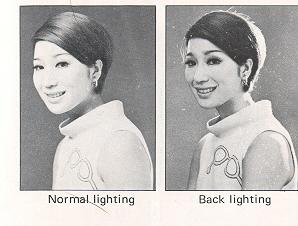 |
When the light is available from the back of the subject and your main
subject is comparatively darker than the back-ground, it is recommended
to adjust the exposure condition. The procedure is same as required when
the important subject is dark. (Refer to TO ADJUST THE EXPOSURE CONDITION
at page 15.) First, set the exposure in the EE photography and read the f/number in the viewfinder. Then, rotate the diaphragm ring to the right and set the f/number at a half or one stop closer to the full aperture than the f/number indicated in the viewfinder when you have set the exposure for the EE photography.
|
VIEWFINDER AND FOCUSING
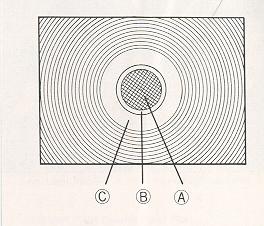 |
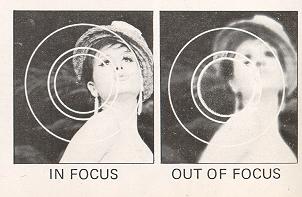
PETRI FT EE has the original PETRI Micromatic Focusing system for fast and accurate focusing. The precision focusing elements in the viewfinder consist of a group of more than 800 micro-prisms as shown in the center of the picture. As you look through the micro-prism area (A) in the viewfinder, you can
see the subject clearly, ON LY when it is correctly focused. Rotating the
focusing ring you will notice the appearance of something like a mesh of
a net in the center of the viewfinder. This reticulation is caused by the
flickering of reflected light entering the camera lens. When the subject
is correctly focused the flickering grid fades away from the micro-prism
area. In the second inner circle (B) is the plain glass area where the subject
is always seen sharp and clear, even when the lens is out of focus. When
the lens is correctly focused the image in the micro-prism area will be
as sharp and clear as that seen in the surrounding circle (C) |
DEPTH OF FIELD
 |
A lens that can be focused lets you accentuate the important image in a picture, while it can de-emphasize irrelevant objects in front of and behind the main subject by throwing them out of focus. This involves what is known as "Depth of Field". The smaller the aperture is the more the depth-of-field increases. |
HOW TO READ THE DEPTH OF FIELD
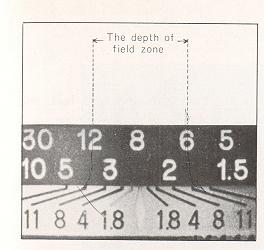
The scale is engraved
on the lens barrel of your camera and indicated in black lines spreading out both
sides of the index marker at the center. Simply focus the lens in the normal way,
and each pair of black lines which points to the diaphragm scale indicates the depth-of-field
zone corresponding to the diaphragm you set.
For example, the depth-of-field
zone for the standard 55mm lens is indicated as follows: When the focusing distance
is 8 feet and the f/11 is selected, one of black lines at f/11 points to 6 feet,
the nearest point still in focus, and the other points to approximately 12 feet
on the other side, being the furthest distance in focus.
PETRI
F/1.8 55mm DEPTH OF FIELD TABLE
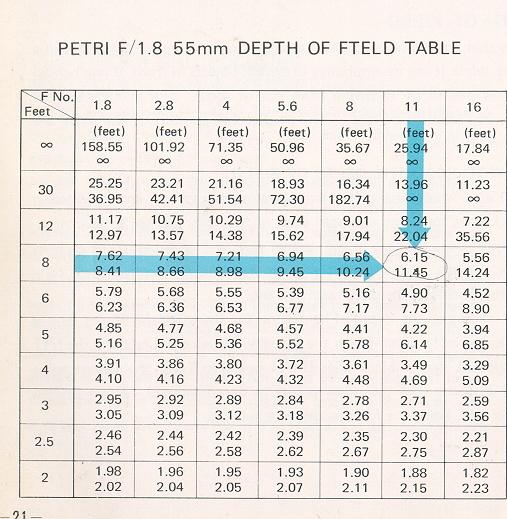
The figures corresponding to 8 feet and f/11 are shown as 6.15 and 11.45, that is
6.15 feet, the nearest point in focus, and 11.45 feet, the furthest distance in
focus.
HOW TO HOLD YOUR PETRI FT EE CAMERA
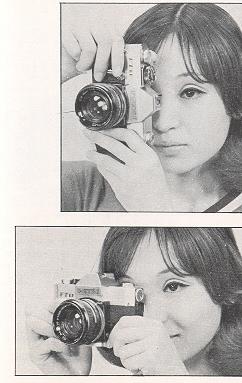 |
The format of your picture is determined by the position in which you hold the camera. Holding the widest part in a horizontal position will result in a horizontal format. Holding the widest part in a vertical position will result in a vertical format. Blurring in a picture often is caused by camera shake at the moment of exposure. Practice holding the camera and releasing the shutter so you can take pictures without jarring or shaking it. Use the following three simple rules for taking a picture to avoid camera movement: 1. Before releasing the shutter, take a deep breath and hold it until after the picture has been taken. 2. While taking the picture, hold the camera firmly with both hands and press the back against your face and forehead as firmly as possible. 3. Squeeze the shutter release button, do not prod or tap it. Practice squeezing until you can release the shutter without the slightest quiver. |
Fl LM LOAD I NG
PETRI FT EE accepts the standard 35mm cartridges containing 12, 20 or 36-exposure
lengths of film. Avoid direct sunlight falling on the film cartridge.
Load
the film in a shade, using your body with your back to the sun as protection if
you have no other method.
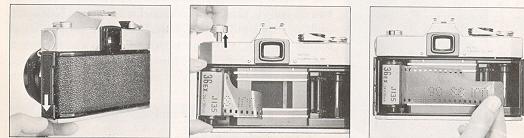
1. TO OPEN THE CAMERA BACK
Pull down the lever with your thumbnail and open
the camera back. At the same time, the exposure counter automatically returns to
"S" (which means "Start") position.
2. TO PULL OUT THE KNOB
Pull out
the film rewind knob on top of the camera. This is to allow the film cassette to
be put into the cassette chamber.
3. FILM LOADING
Slip the film end into
any slit on the take-up spool and slide it down toward the bottom of the camera
body, and check that the film perforation is properly engaged with the tooth of
camera sprocket.
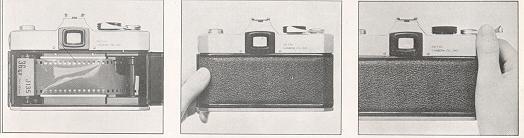
4. TO ADVANCE THE FI LM
Advance the film advance lever a little and see that
the film is fastened round the take-up spool, before closing the camera back.
5. TO CLOSE THE CAMERA BACK
The camera back will be locked with
a snap by a slight pressure.
6. TO RELEASE THE SHUTTER AND ADVANCE THE FILM
Repeat this action twice, and you are ready to take your first picture.
NOTE: In case the film rewind knob does not turn counterclockwise by advancing
the film advance lever, it shows that the film is not properly transported. Open
the camera back and check the take-up spool.
FILM UNLOADING
After the entire length of film in the cartridge has been exposed,
it must be removed into the film cartridge so it can be removed from the camera.
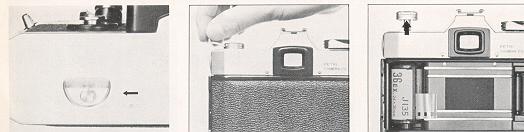
1. TO REWIND THE FILM
Depress the film rewind button located on bottom
of the camera body. Raise the film rewind crank and turn it in the direction indicated
by the arrow. You will feel a little tension on the crank while the film is being
rewound. When the tension stops, you know that the rewinding is complete.
2. TO REMOVE THE CARTRIDGE
Pull out the film rewind knob and remove the
film cartridge. Avoid direct sunlight when removing the film cartridge from
the camera. Also, the camera lens should face downward while the cartridge is being
removed so as to prevent it from dropping out.
HOW TO CHANG E YOU R LENS
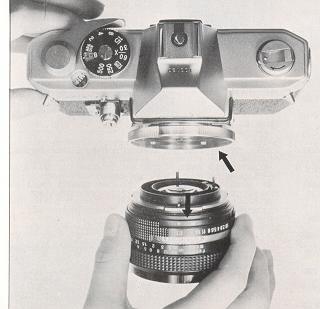 |
( 1 ) REMOVING THE LENS Turn the Lens Mount Ring in a counterclockwise direction until the red mark appears on top of the lens barrel. The lens can then be removed from the camera. (2) INSERTING THE LENS Line up the red dot on the camera body with that on the lens mount ring. Then insert the lens making sure that the protruding lock on the bayonet mount of the lens is on the top. When the lens is in position, turn the lens mount ring tightly in a clockwise direction. |
FLASH PHOTOGRAPHY
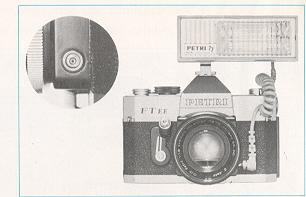 |
When the exposure meter needle in the EE photography jumps up to the under-exposure warning mark (see page 14) and even a slower shutter speed can never make it come down to the diaphragm scale area, it shows that the lighting condition is too poor and that you must switch to flash photography. Photography with flash not only extends your picture possibilities greatly but adds excitement and drama to your pictures. The use of flash equipment with your camera is relatively simple because it has built-in synchronization. It is equipped with X synchronization. (The shutter speed at "X" is 1/45 second.) Therefore, both electronic flash and ordinary single exposure flashbulbs can be used. |
PETRI FT EE is equipped with both a "hot shoe" contact for cordless unit
and a standard PC terminal for one that has a cord. If you use a cordless unit,
merely slip the foot of the unit into the shoe on top of the camera body and it
will automatically make contact with the shutter mechanism. If the unit has a cord,
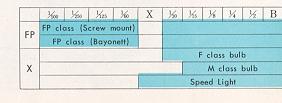
simply plug the cord into the PC flash outlet. When using F class, M class and FP
class flashbulbs, or an electronic flash unit, shutter speeds must be selected according
to the table. (Speeds within the colored area are available.)
EXPOSURE CONTROL IN FLASH PHOTOGRAPHY
 |
In flash photography the FE exposure control can not be used. The exposure depends on the shutter speed, the aperture opening, the film speed and the distance of the light from the subject, but if the shutter speed is constant and also the film speed is assumed to be constant, then the f/number required varies according to the lamp-to-subject distance. |
In another word, for any given shutter speed and film speed, the product of the
aperture opening and the lamp-to-subject distance becomes a constant, and this constant
is called the Guide Number. Thus, the f/number is calculated by the following formula:
Guide Number = Distance x f/number OR YOU CAN USE f/number =
Guide Number / Distance
For example, in case a flashbulb of the FP class is used and the guide number
corresponding to the ASA (or DIN) index and to the shutter speed selected is supposed
to be 74, then the f/number, if the lamp-to-subject distance is 10 feet, will be
about 8, because 74 / 10=7.4 / 8. No great accuracy is required in this calculation,
and a quick mental division will give an f/number for any distance. In all cases,
the nearest click-stop or 1/2 stop will be close enough for a practical work. The
guide numbers are usually indicated on the packages of your flashbulbs or in the
instruction manual of your strobe.
HOW TO USE BUILT-IN SELF-TIMER
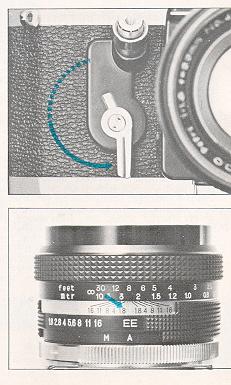 |
Swing the self-timer lever in the direction
indicated by the arrow as illustrated. Release the shutter button, and the
frame will be exposed after a delay of approximately 9 seconds. The self-timer
can be set at between positions within the range of solid line) so as to
shorten the release time and also be set either before or after advancing
the film. All shutter speeds except B setting can be used with the self-timer.
The self-timer is usually used when the photographer wants to join a group which he is photographing. It is also useful for photomicrography or when using a long focal length lens. In all cases the use of a tripod is recommended. |
INFRA-RED PHOTOGRAPHY
When taking infra-red pictures, reset the focusing distance to the red line indicated
by the aperture f/1.8 on the Depth of Field Scale.
MAINTENANCE AND
CARE OF YOUR PETRI FT EE
A few simple precautions, careful handling
and immediate attention in case of trouble will prolong the life of your camera
and keep it operating well in definitely. Follow these simple rules:
1.
When cleaning the outside of the camera, first use a soft brush and then a soft
cloth.
2. Remove dust and sand that enter the camera while it is open immediately,
using a camel-hair brush or a hand-blower.
3. Dust, fingerprints, water
drops, etc., on the lens not only affect picture contrast but, if left for a long
time, they will attack the surface.
4. Should your camera fall into water,
immediate attention is imperative. Bring it to a repair shop at once. If it falls
into salt water, rinse it thoroughly in fresh water and then deliver it to the repairman.
5. Your camera, when not in use, should be protected from damp and dust.
Preferably in its case and, as an additional precaution, inserted into a polythene
bag.
6. Be sure that your camera is not kept in abnormally high or low temperatures--normal
room temperature is best.
7. Before storage, release the shutter and relieve
a tension of every apparatus. When you store your camera for a prolonged period,
remove a battery and avoid a risk of deterioration and corrosion.
8. Do
not leave your camera without use for along period. Your camera, as any other me
chanical instrument, needs to be exercised regularly to keep it in good condition.
Set the shutter release and fire, turn to a slow shutter speed and again set the
shutter release and fire.
Also, operate the self-timer. Examine the exposure
meter for correct operation. Check film transport. Check the Pentaprism view finder.
These actions will keep the mechanism in good order, retaining the natural qualities
of the lubricant--thus ensuring your camera is ready for an instant use when required.
PETRI INTERCHAGEABLE LENSES
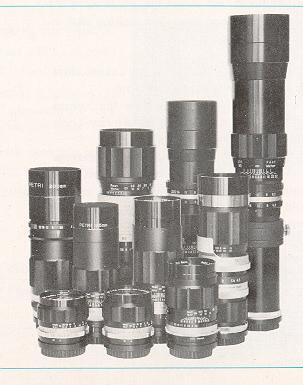 |
PETRI FT EE accepts a wide range of Petri interchangeable lenses from 28mm wide angle to 1000mm telephoto, unparalleled in quality and design. The built-in CdS meter is geared to these interchangeable lenses which include Petri's original Periscope telephoto lens. Petri 35mm f/3.5 and 135mm f/3.8 both with the automatic diaphragm, specially designed for PETRI FT EE, allow the automatic exposure control and therefore, specify these lenses when you buy the 35mm and 135mm focal length lenses. Other interchangeable lenses are not fully coupled to the EE system. (As to the exposure control for the normal lenses, see TO USE NORMAL LENSES at page 16.) |
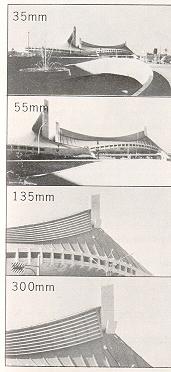 |
28mm ft3.5 wide angle with automatic diaphragm 35mm f/2.8 wide angle with automatic diaphragm, special design for the FT EE 100mm f/4.5 Periscope telephoto with preset diaphragm 135mm f/3.5 telephoto with automatic diaphragm 135mm f/3.8 telephoto with automatic diaphragm, special design for the FT EE 200mm f/4 telephoto with automatic diaphragm 300mm f/5.5 telephoto with preset diaphragm 400mm f/6.3 telephoto with preset diaphragm 500mm f/5.6 telephoto with preset diaphragm 1000mm f/8 telephoto with preset diaphragm 80 ~ 200mm f/4.5 Zoom with automatic diaphragm 85 ~ 210mm f/4.8 Zoom with preset diaphragm |
PETR I ACCESSORIES
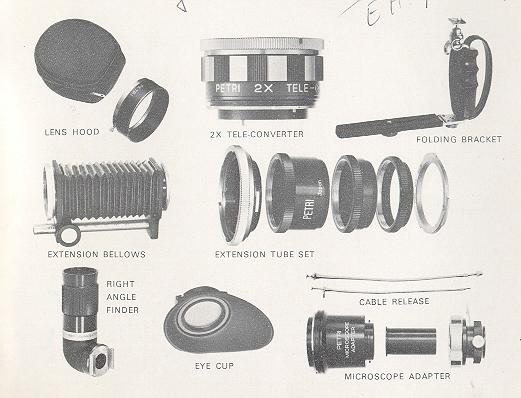
A complete range of filters,
lens hood and other attachments such as extension tubes, bellows, eye-cups, etc.
are available to meet any photographic situation. Through-The-Lens exposure system
equipped in your PETRI FT EE gives the optimum exposure reading even when using
filters, close-up units or in photomicrography.
FILTERS
Essential for first class photographs. Select the proper filters for your needs.
For Black & White Film:
| FILTER | TYPE FACTOR | COLOR | PURPOSE |
| Y1 | 1.5X | Light Yellow | Landscapes, snow, clouds. Renders yellow and green lighter. |
| Y2 | 2 X | Medium Yellow | Gives stronger effect than Y1. |
| YA3 | 4 X | Orange | Haze distant views. Renders yellow and red lighter, blue darker, distant objects clearer. |
| R1 | 8 X | Red | Hazy distant views. Renders red lighter, blue and green darker. Gives stronger effect than orange filter. |
| PO0 | 2.5X | Green Landscapes, snow, clouds. Renders green lighter. Red (complexion) and blue darker. Recommendable for portraiture. | |
| P01 | 4 X | Medium Green | Gives stronger effect than PO0. |
For Color Film:
| FILTER TYPE | FILTER COLOR | PURPOSE |
| UV | no increase | Clear Absorbs excessive UV. Also suitable for black-and-white. |
| 1 A | no increase | Light Pink To eliminate haze and for use at altitudes over 3,000 ft. |
| W4 | 1.5X | Medium Amber Reduces excessive blueness of sky on a cloudy dad. |
| C4 | 1.5X | Medium Blue For early morning or evening shots. |
| C8 | 2 X | Dark Blue Conversion filter for use when using 'Daylight Type' color reversal film with white flash bulbs. |
| C12 | 2.5X | Dark Blue Conversion filter for use when using 'Daylight Type' color film with photoflood lamps. |
| 85C | no increase | Dark Amber Conversion filter for use when using 'Artificial Light' film in daylight. |
| NDX4 | 4 X | Neutral Density Neutral Density for sunny subjects. Can also be used for black and-white. Allows slower shutters in daylight to blue images (eg streams or waves) |